
Category: Market news
Spain’s latest housing decree has survived its vote in Congress – just. If you own a home on the Costa del Sol, or you’re planning to buy one, you may be wondering whether it affects you. The short answer: if you’re buying a home to enjoy yourself, very little changes. If you let your home, leave a second home empty or are planning to sell, there are changes worth knowing about. And with a general election on 29 November and the main opposition party, the Partido Popular (PP), promising to repeal these measures, the picture may not stay the same for long.
What was approved this week
On 12 November, Congress’s standing committee (the Diputación Permanente, which acts while parliament is dissolved before an election) validated Royal Decree-law 29/2026 by a single vote, 35 to 34. PSOE, Sumar, PNV, ERC, Bildu and Podemos voted in favour; PP, Vox and Junts voted against. A second decree, 28/2026, which would have turned many rental contracts into indefinite ones, was rejected and will not come into force.
The validated decree has applied since 8 October and covers rental rules, tax changes and protection for vulnerable tenants. The main points for our buyers and owners are below.
The PP has said it will repeal the measures
This is the most important context for anyone making decisions now. On 12 November, PP leader Alberto Núñez Feijóo said that if he becomes prime minister after the 29 November election, he will repeal the government’s housing decree-laws, describing them as bad for both tenants and owners. The PP has also said it would repeal the 2023 Housing Law and replace it with a plan to build one million homes, a new land law and faster action against squatting.
What happens next therefore depends on the election result and on the parliamentary steps that would follow. A repeal would not be immediate, and until any change is made the decree is in force. For buyers, the sensible approach is to understand the current rules without assuming they are permanent – and to take advice before making decisions based on them.
Buying a home to use yourself: no new restrictions
The decree limits purchases by large holders and investment funds of homes sold at below 70% of their appraised value until 2030. It does not restrict individuals buying a home to live in or to use as a holiday home, whether you’re from Spain, the UK, Ireland or elsewhere.
Holiday lets: 10% VAT from 1 December
Furnished homes let for stays of 30 nights or fewer to the same guest lose their VAT exemption from 1 December 2026 and pay VAT at 10%, the same rate as hotels. Town halls in areas formally declared as stressed housing markets may also add an IBI (council tax) surcharge on tourist homes of up to 50%, 100% or 150%, depending on how many the owner has. This is optional for each council.
If you already let your home, or plan to, speak to your gestor or tax adviser about registration and returns. Our guide to holiday-letting on the Costa del Sol covers the local licensing rules, which are a separate matter.
Second homes left empty: a new tax scale from 2027
Owners pay income tax on a notional (“imputed”) income from homes that aren’t let or used as a main residence. From 1 January 2027, the flat rate is replaced by a progressive scale on the combined cadastral value of all such properties: 1.1% up to €100,000, 1.5% up to €500,000, 2% up to €1 million and 3% above that. Tax advisers expect this to apply to non-resident owners too. One worked example: two empty homes with a combined cadastral value of €600,000 would see imputed income rise from €6,600 to €9,100. Councils can also add IBI surcharges on homes that are genuinely left vacant, with exemptions for justified cases.
Our article on the non-resident property tax return explains how this tax works today.
Long-term and seasonal lets: the new rules
For landlords, seasonal contracts must now have a genuine reason and generally cannot exceed 12 months; annual rent increases are capped until the end of 2027; tenants can ask for up to two extra years on some leases ending before the end of 2028; and landlords who let below the reference rent can claim income tax reductions of up to 100%.
Selling: new plusvalía coefficients
From 1 December, the state maximum coefficients for the municipal plusvalía tax change. For homes owned for 20 years or more, the maximum falls from 0.40 to 0.30. Councils must update their bylaws, and only coefficients within the new limits can be applied in the meantime.
What happens next
The decree is in force today, but its future is uncertain. If the PP forms a government after 29 November, it has promised to repeal these measures; if not, they are likely to remain. Either way, buying a home to enjoy yourself is not affected, and the changes mainly concern lettings, empty second homes and plusvalía. Our article on what the 29 November election could mean for buyers looks at the wider picture.
This article is general information, not tax or legal advice. If you’d like to talk it through, speak to a Mosaic advisor – we can introduce you to independent tax advisers and lawyers – or download our free 2026 Buyers Guide.
Sources
- idealista/news – The standing committee validates the housing decree and rejects the indefinite-lease decree (12 Nov 2026)
- Moncloa.com – Feijóo promises to repeal the housing decrees (12 Nov 2026)
- Infobae / Europa Press – The housing decree the PP will repeal if it governs (11 Nov 2026)
- Economist & Jurist – Tax measures in Royal Decree-law 29/2026
- Gentile Law – Imputed property income: the new progressive scale for 2027
If you are planning to buy on the Costa del Sol with a Spanish mortgage, one number matters more than most: the 12-month euríbor, the benchmark that most Spanish variable and mixed-rate mortgages are linked to. In October 2026 it averaged 3.239%, according to the Banco de España – about a full percentage point higher than a year earlier. Here is what that means in plain terms, and how to plan a purchase around it.
Where the euríbor stands now
The Banco de España’s official figure for October was 3.239%, just below September’s 3.247% and up 1.052 points on the year (October 2025: 2.187%). In the first days of November the daily rate has stayed slightly higher, at around 3.28–3.32%, giving a provisional November average of about 3.30% after four sessions, according to Rankia. In short, rates have levelled off at a higher plateau rather than continuing to climb steeply.
Why rates have risen: the ECB’s 2026 moves
The euríbor tracks expectations for European Central Bank policy. After raising rates in June and September 2026, the ECB held its deposit rate at 2.50% at its meeting on 29 October. Its next decision is due on 17 December, and Rankia reports that markets expect another quarter-point rise – a reminder that the outlook is still uncertain while inflation remains above target.
What it means in euros
For existing borrowers on variable rates, the rise shows up at each annual review. idealista calculates that a €150,000 mortgage over 25 years at euríbor plus 1% costs about €1,000 more a year than it did twelve months ago – roughly €83 a month – and a €300,000 loan about €2,100 more a year. The comparison site Kelisto estimates that a typical borrower whose annual review falls this month will pay around €100 a month more – about €1,206 a year, an average rise of 11.3%. Your own figures will depend on the amount, term and margin, but those examples give a sense of scale.
For new buyers, the effect is mainly on how much you choose to borrow and whether to fix. Many overseas buyers combine savings or equity from home with a Spanish mortgage, so even a modest change in rates can shift what feels like a comfortable budget. It is worth running the numbers before you start viewing, not after you have found the right home.
Fixed or variable? What Spanish buyers are choosing
Spain’s statistics office, the INE, recorded 33,841 home mortgages in August 2026, up 2.3% on a year earlier, with an average loan of €181,285. The average starting interest rate was 3.08%. Almost two-thirds of new home loans (64.1%) were fixed-rate, at an average of 3.16%, against 2.95% for variable-rate loans. The average term was 26 years. Because the INE counts mortgages when they are registered, many of these were agreed before the ECB’s September rise.
Even after this year’s rises, Spanish mortgages remain among the cheapest in Europe. ECB figures reported by Euronews put the average rate on new home loans in Spain at 2.80% in April 2026, against a eurozone average of 3.43% – the third lowest of the countries compared. In the UK, the Bank of England’s effective rate on newly drawn mortgages was 4.60% in August 2026. The measures and months differ, and the rate any individual buyer is offered will depend on their profile, but the gap is a useful reminder for buyers comparing financing at home and in Spain.
The choice comes down to certainty versus cost. A fixed rate means your payments are known for the life of the loan, which many overseas buyers value when they are also managing currency movements. A variable or mixed rate can start lower, but you carry the risk if the euríbor rises further.
What forecasters expect
Forecasts differ, which is itself a useful message. idealista reports that CaixaBank Research sees the 12-month euríbor ending 2026 at around 3.4%, while Bankinter expects a December average of 3.1–3.3%. Some analysts think rates are close to their peak; others warn that persistent inflation and energy prices could push them higher. Nobody can promise where rates will be when your mortgage is reviewed, so plan for a range rather than a single number.
Planning a Costa del Sol purchase with a mortgage
- Get a mortgage in principle early. Spanish banks usually lend non-residents a lower share of the price than residents, so know your figures before you reserve.
- Compare fixed, variable and mixed offers on the total cost over the term, not just the opening rate.
- Stress-test your payments. Check you would be comfortable if rates were a point higher than today.
- Plan your currency. If you earn in sterling, exchange-rate movements can matter as much as the interest rate.
- Think about timing on off-plan purchases. With a new build, the mortgage is usually only needed at completion, which may be a year or two away – leave room for rates to move in either direction.
Our guide on how to secure a Spanish mortgage as a non-resident buyer walks through the process, documents and typical loan-to-value limits. For the bigger picture, download our free 2026 Buyers Guide, or speak to a Mosaic advisor – we work with independent mortgage brokers who can compare offers for you.
This article is general information, not financial advice. Please speak to a qualified mortgage adviser about your own circumstances.
Sources
- Banco de España, 3 November 2026 – Official mortgage reference rates for October 2026
- idealista/news, 30 October 2026 – The euríbor closes October at 3.23%
- Kelisto – The euríbor slows in October but still makes mortgages dearer
- Rankia, 6 November 2026 – Euríbor today
- Euronews, 18 June 2026 – Where are the lowest and highest mortgage rates in the eurozone? (ECB data)
- Bank of England – Effective interest rates, August 2026
- INE – Mortgage statistics, August 2026 (figures as reported by hipotecas.me)
Spain goes to the polls on Sunday 29 November in a snap general election, and housing is at the centre of the campaign. If you’re planning to buy on the Costa del Sol this winter, you’ll see plenty of headlines over the next few weeks, and some of them will be alarming. Here’s a calm, neutral look at what is actually on the table, what isn’t, and what it could mean for you as an overseas buyer.
Why Spain is voting on 29 November
The election was called after Congress rejected the government’s emergency housing decrees on 2 October, with the PP, Vox and Junts voting against. Royal Decree 806/2026, published in the BOE, dissolved the Cortes and set the date. The official campaign runs from 13 to 27 November, and the new parliament is due to sit on 23 December.
The government has since approved revised versions of most of the rejected measures, which go before parliament’s Permanent Deputation (the body that sits while parliament is dissolved). Those measures mainly concern tenants, temporary rentals, tourist accommodation and large investors, rather than people buying a home to use themselves.
Housing is the issue of this campaign
Housing has become the defining political issue in Spain, with every major party promising to tackle affordability. For buyers, the important point is that these are election proposals, not laws. What any future government can actually pass will depend on the make-up of the new parliament – and on any coalition deals that follow.
What the main parties are proposing
PSOE (the governing party) says that, if re-elected, it will intervene more in the housing market. It points to its national Housing Law, longer minimum rental contracts and a €7 billion State Housing Plan to 2030. It also wants holiday accommodation taxed more like a business and temporary rentals regulated more tightly. Its full manifesto was still being drafted in late October.
PP (the main opposition party) puts supply first. It talks of building around 200,000 homes a year, speeding up licences with a “declaración responsable” (a sworn declaration instead of waiting for a permit), releasing public land for price-capped homes, a state guarantee of up to 15% of a mortgage for young buyers, and repealing the current Housing Law, including its rent controls. It opposes restrictions on second-home purchases and temporary rentals.
Vox also wants land released faster and more public housing built. It proposes a “national priority” for Spaniards in access to protected housing and a differentiated tax that would penalise large property purchases by non-EU buyers.
The “100% tax” on non-EU buyers: what it really is
No proposal has caused more worry among British buyers, so it’s worth being precise.
- What it was: In January 2025 the Prime Minister announced a tax of up to 100% on homes bought by non-EU, non-resident buyers, and the PSOE registered a bill in Congress in May 2025. As drafted, it would be a state surcharge on top of the regional transfer tax, with the transfer tax already paid deducted from it.
- Who it would affect: Only non-EU nationals who are not tax resident in Spain. Since Brexit, that includes UK buyers. EU and EEA citizens, and non-EU nationals who live in Spain, are outside its scope.
- New builds are excluded: The bill does not apply to sales by developers that are subject to VAT, which covers most new-build purchases. In Andalucía, a new-build home bought from a developer pays 10% VAT plus 1.2% stamp duty (AJD). A resale home pays 7% transfer tax (ITP). So even as drafted, a non-EU buyer purchasing a new build from a developer would sidestep it entirely, paying the normal VAT rather than the resale transfer tax the surcharge was built on.
A bill that went nowhere
The proposal never progressed. It was never debated in Congress and never had a majority behind it: Junts opposed it, and the opposition PP said it would never use nationality as a criterion for taxing buyers. It was left out of the government’s January 2026 housing package. When parliament was dissolved for this election, every bill still pending lapsed (article 207 of the Congress Rules). If any party wanted to revive it, it would have to start again as a brand-new bill and win a majority in the new parliament.
Serious legal and constitutional objections
Even if it were reintroduced, the measure would face the same significant legal hurdles that make it very difficult to pass in its original form:
- EU law: Article 63 of the Treaty on the Functioning of the European Union protects the free movement of capital, including movements between EU countries and non-EU countries. Targeting non-EU buyers rather than EU citizens does not automatically make a tax compatible with EU law, and the EU Court of Justice has repeatedly ruled against Spain and other member states over tax rules that discriminate against non-residents.
- Discrimination and proportionality: Baker McKenzie and other specialists have questioned whether a tax that treats buyers so differently by residence, at a 100% rate, could meet the principle of proportionality.
- The Spanish Constitution: Article 31 forbids taxes of a confiscatory nature. The Registry of Economists and Tax Advisors (REAF), part of Spain’s General Council of Economists, said the tax would very likely be considered confiscatory.
- Expert assessments: In August 2025, the international law firm Baker McKenzie concluded that the proposal was unlikely to survive legal scrutiny in its current form, and expected immediate challenges in the Spanish and European courts if it were ever enacted. Other Spanish tax lawyers have warned that the European Commission would be likely to open infringement proceedings.
Much of the press coverage has made it sound as though the tax is in force, or as though it would apply to every home a foreign buyer purchases. Neither is the case, and that reporting has caused real and unnecessary alarm among non-EU buyers. Vox’s own proposal for a differentiated tax on large non-EU purchases has no published rate or detail, and would raise the same legal questions.
What could and couldn’t change for you
Today, the main purchase taxes are the same for Spanish and foreign buyers. What matters is whether the home is new or resale, and where you are tax resident. Non-residents do have their own annual obligations, such as non-resident income tax, but those are not new and not part of this debate.
The areas most likely to shift after the election are rental rules (long-term and temporary lets), holiday-let taxation, and the planning and supply measures each side is promising. If you’re buying mainly to use the home yourself, and especially if you’re buying a new build from a developer, the debate is likely to touch you far less than the headlines suggest.
Should you wait until after the vote?
That’s a personal decision, but a few practical points help:
- Tax and legal rules don’t change on election night. Any new tax needs a law to be passed and published, and that takes time.
- The new parliament only sits from 23 December. Forming a government and passing legislation will take longer still.
- Purchase taxes are due when the sale completes, not when you reserve. If you’re signing now for a completion months or years away, ask your lawyer how any future change could apply to you.
- If you’re buying off-plan, make sure every stage payment is properly guaranteed. Our guide to how your deposit is protected explains how.
We’ll keep following the campaign and will update our clients on anything that affects buyers once firm proposals and results are known.
Talk to a Mosaic advisor
If you have questions about buying on the Costa del Sol before or after the election, speak to one of our advisors or download our free 2026 Buyers Guide. For residency routes, see our Residency Options page.
This article is general information, not legal, tax or political advice. Proposals may change during the campaign. Always take independent legal advice before you buy.
Sources
- LegalToday (6 Oct 2026) – BOE publishes the dissolution of the Cortes and the call for elections on 29 November
- LegalToday (12 Oct 2026) – Dissolution of the Cortes: pending initiatives lapse (art. 207 Congress Rules)
- idealista (23 Oct 2026) – Spain’s government promises tougher housing rules if it wins the November election
- The Local (6 Oct 2026) – How the PP and Vox say they’ll fix Spain’s housing crisis
- Your Overseas Home (Oct 2026) – Spain election 2026: what it means for property buyers
- Spanish Property Insight (25 May 2025) – PSOE bill to tax non-resident buyers from outside the EU
- Baker McKenzie (14 Aug 2025) – Spain: new real estate tax reforms
- thinkSPAIN (upd. 9 Jun 2025) – Foreign buyer tax proposal “not workable”, including REAF’s view
- Gómez-Acebo & Pombo / El Confidencial (2 Jun 2025) – Legal risks of the 100% tax on non-EU investors
- The Local (12 Feb 2026) – What happened to Spain’s 100% property tax for foreign buyers?
- Vicox Legal – Spain’s non-EU buyer property tax: status in 2026
- Interforo Abogados (13 Apr 2026) – Taxes on buying a home in Andalucía, 2026 guide
- Infobae (8 Apr 2026) – What the law says about the taxes foreigners pay to buy a home in Spain
Spanish property prices reached another milestone in October. According to idealista’s monthly report, published on 4 November, the average asking price for a resale home in Spain reached €2,955 per square metre – the highest figure since its records began in 2006, and 11.2% more than a year ago. Málaga province, at €4,322/m², is now the fourth most expensive province in the country, behind only the Balearic Islands, Madrid and Gipuzkoa.
A provincial average hides a great deal, though. Along the Costa del Sol, prices are moving at very different speeds from one town to the next – and the latest forecasts point to steadier, more sustainable growth next year rather than a slowdown. Here is what the numbers show, and what they mean if you are thinking of buying.
Town by town: the latest Costa del Sol figures
The table below uses idealista’s average asking prices for September 2026, the latest month it has published town by town. Click a town to open our area guide.
| Town | Average asking price (€/m²) | Change over 12 months |
|---|---|---|
| Marbella | 5,967 | +3.2% |
| Benahavís | 5,602 | +6.5% |
| Estepona | 5,021 | +17.1% |
| Fuengirola | 4,452 | +1.1% |
| Torremolinos | 4,199 | +7.1% |
| Benalmádena | 4,188 | +5.1% |
| Málaga city | 3,969 | +4.1% |
| Mijas | 3,717 | +8.5% |
| Manilva | 3,043 | +11.3% |
| Málaga province | 4,317 | +6.6% |
A note on these averages: each figure is an average for the whole municipality. It covers every neighbourhood and every size, age and standard of home on the market, from older apartments set back from the coast to front-line villas. idealista’s index is based on resale homes, so new-build developments are not included. In practice, high-quality homes in prime locations, and new-build properties in particular, often sell for well above the average for their town. Land Registry figures for Málaga province show new-build homes registering about 11% more per square metre than resale homes. At the luxury end, prime homes in Marbella, Benahavís and Estepona typically reach €14,000–16,000/m², more than double the town averages above (see below).
Two things stand out. Marbella is still the coast’s most expensive address, but its prices are now rising gently, at around 3% a year – a sign of a mature market rather than an overheated one. And the west of the coast is catching up quickly: Estepona has risen by 17.1% in twelve months and Manilva by 11.3%. Estepona is now only around €580/m² behind Benahavís. Meanwhile Mijas, at €3,717/m², and Manilva, at just over €3,000/m², remain among the more affordable places to buy on this stretch of coast.
The ripple effect: inland and the Axarquía
An El Español analysis of the same idealista data shows that the biggest percentage rises in Málaga province are no longer on the Costa del Sol itself. Almayate Bajo (+28.2%), Archidona (+27.1%), Vélez-Málaga (+26.2%) and Cómpeta (+24.0%) all rose by more than a fifth in a year. These rises start from much lower levels, though: Vélez-Málaga averages €2,249/m² and Archidona €1,263/m². As coastal prices climb, demand is spreading to the towns and villages behind them.
The prime end: Marbella, Benahavís and Estepona
At the top of the market the figures are in a different league. Grupo Tecnitasa’s 2026 report on Spain’s luxury housing market, reported by Qué!, puts the usual range for prime homes in Marbella, Benahavís and Estepona at €14,000–16,000/m², with a handful of front-line beach projects above €40,000/m². Málaga province holds 32% of Spain’s supply of homes priced over €3 million, and Tecnitasa notes that luxury prices across Spain rose by 10.87% in 2025, supported by international demand and a shortage of high-end land on the coast.
Asking prices and selling prices
idealista’s figures are asking prices – what sellers are advertising. The Land Registry (Colegio de Registradores) measures prices actually recorded on completed sales. For Málaga province it shows an average of €3,254/m² over the twelve months to June 2026, up 10.8% on the year before; new-build homes averaged €3,495/m² (+10.5%) and resale homes €3,135/m² (+11.1%). The two measures are not directly comparable, but they point in the same direction: values across the province are rising, for new homes and resales alike.
Looking ahead: steady growth, not a spike
The encouraging news for buyers is that the main forecasters expect Spanish prices to keep rising in 2027, but at a calmer, more sustainable pace. BBVA Research, in its August 2026 outlook, forecasts a 12% rise in 2026 easing to 5.7% in 2027. S&P Global Ratings expects 7.4% next year and Bankinter around 4%. None of these forecasts points to falling prices.
The reasons are structural. BBVA Research estimates that Spain’s housing shortfall will grow to around 885,000 homes by 2027, as new building continues to lag behind the number of new households. Demand is supported by job and wage growth and by what it calls relevant foreign demand. For anyone buying on the Costa del Sol, that combination – limited supply, steady demand and slower, healthier price growth – is a good basis for confidence that the market will keep moving forward. Forecasts are not guarantees, of course, but the direction is clear.
What it means if you’re buying this winter
- Compare price per square metre, not just headline prices. The gap between towns is wide – from around €3,000/m² in Manilva to almost €6,000/m² in Marbella.
- Look beyond the obvious names. Mijas, Benalmádena and Manilva offer beach and airport access at lower average prices than Marbella or Benahavís.
- Weigh new-build against resale. New-build homes register at around 11% more per square metre than resale homes in Málaga province. The choice comes down to budget, specification, timing and payment schedule. Browse our new developments to compare.
- Plan your financing early. Our guide to getting a Spanish mortgage as a non-resident explains the steps.
For a fuller picture of the market, see our recent article on record foreign buying in Spain, or download our free 2026 Costa del Sol Market Report & Buyers Guide. If you would like to know how prices compare for the type of home you have in mind, a Mosaic advisor will be happy to talk it through.
Sources
- idealista/news – El precio de la vivienda usada en venta alcanza nuevo máximo en octubre (4 Nov 2026)
- idealista – Price report, Málaga province by municipality (September 2026)
- El Español Málaga – La gran subida de la vivienda en Málaga ya no está en la costa (15 Oct 2026)
- Qué! – Tecnitasa luxury housing report: Costa del Sol prices (9 Oct 2026)
- Colegio de Registradores – Estadística Registral Inmobiliaria, Q2 2026
- BBVA – BBVA Research housing outlook 2026–2027 (10 Aug 2026)
- Rankia – Previsión del precio de la vivienda en España 2027 (updated 1 Oct 2026)
This article is for general information only and is not financial advice. Figures are averages and individual properties vary.
Spain’s property market sent a mixed message this summer. Fewer homes changed hands, yet buyers from abroad bought more than ever. For anyone weighing up a home on the Costa del Sol, the latest official figures are worth a closer look. They show how much competition there is for good property here, and where prices are heading.
A record share for international buyers
According to the Colegio de Registradores (Spain’s Property Registrars), foreign buyers made up 15.98% of all home purchases in Spain between April and June 2026. That is the highest share since their records began, and up from 13.92% in the first quarter. In numbers, it means a little over 26,800 homes bought by foreigners in three months.
What makes this stand out is the backdrop. Total sales fell 5.7% on the previous quarter, to 167,934. Over the first half of the year, idealista’s reading of the same data puts foreign purchases at a record 51,630, while overall sales dipped 1.9% year on year. Local demand has eased a little. International demand has not.
Málaga: more than one in three buyers from abroad
Málaga province is one of the places where this shows most clearly. In the second quarter, 37.01% of home purchases there were made by foreign buyers. Only Alicante had a higher share, at 46.43%.
The province also bucked the national trend on volume. Registradores recorded 9,387 sales in Málaga in the quarter, 7.7% more than in the first three months of the year. Most of that growth came from resale homes. New-build sales fell 7.0% on the quarter, and in our experience that tends to reflect how few finished new homes are available at any one time.
For our clients, the practical point is simple. Across the province, more than one buyer in three comes from abroad, so you are rarely the only international buyer looking at the same kind of home.
Who is buying? The British still lead
British buyers remain the largest single nationality. They made 1,843 purchases in the second quarter, or 6.99% of all foreign purchases in Spain. Over the first half of the year they were narrowly ahead of Dutch, Moroccan and German buyers, idealista reports, followed by Romanian, Italian, French, Polish and Belgian buyers.
Swedish buyers also appear in the top fifteen, a reminder that Northern European demand is broad, not just British.
Prices: still rising, but more gently
Prices are firm. The National Statistics Institute (INE) reported that Spanish house prices rose 12.2% year on year in the second quarter, with Andalucía up 11.9%. Interestingly, new homes rose more slowly (7.4%) than resale homes (12.9%) nationally.
In Málaga province, Registradores put the average registered price at €3,254 per m² over the twelve months to June, up 10.8% on a year earlier. For new-build homes it was €3,495 per m², up 10.5%. Quarter on quarter, the provincial price barely moved (+0.2%).
More recent valuation data from Gesvalt, reported by The Olive Press, points the same way. It puts Málaga province at €3,149 per m² in the third quarter, up 8.9% on a year earlier, and describes the trend as “a certain normalisation”. In other words, prices are still climbing, but the pace of growth is easing.
Mortgages: what buyers can expect
Financing has been stable. The average rate on new mortgages in Spain was 3.03% in the second quarter, and 63.83% of new loans were on a fixed rate, at an average of 2.92%, according to Registradores.
These figures cover all borrowers. Non-resident buyers usually face lower loan-to-value limits and slightly different terms, so it pays to get an agreement in principle early. Our Buying in Spain guide explains the process step by step.
What about the proposed tax on non-EU buyers?
Many UK clients ask about the proposal for a 100% tax on non-EU, non-resident buyers. As of October 2026 it is not law. It was put forward in 2025 but, as Vicox Legal notes, it has not been debated or approved by Congress, and it was left out of the January 2026 housing reform package. We will keep watching it and report any real change, but for now the usual purchase taxes apply.
What this means if you are buying in 2026
- Expect competition for the best homes. With over a third of Málaga purchases made by foreign buyers, popular new developments can sell their best units at launch.
- Plan your budget, not just the price. Purchase taxes, notary, registry and legal fees typically add a significant amount on top, so budget for them from the start.
- Arrange finance early. Stable rates are helpful, but non-resident approvals take time.
- Be ready to move. Having your NIE, a lawyer and your deposit lined up lets you reserve with confidence.
If you would like to talk through what these figures mean for your plans, a Mosaic advisor will be happy to help. You can also browse current new developments on the Costa del Sol or download our free 2026 Buyers Guide from the Buying in Spain page.
Sources
- Estadística Registral Inmobiliaria, 2nd quarter 2026 – Colegio de Registradores
- Foreign buyers set home purchase record in Spain despite slowdown – idealista, 13 October 2026
- Housing Price Index, 2nd quarter 2026 – INE, 7 September 2026
- Málaga property prices and rents climb – The Olive Press, 19 October 2026
- Spain’s 100% tax on non-EU property buyers: is it law in 2026? – Vicox Legal, 2 October 2026
Featured image: a Mosaic Realty sea-view terrace on the Costa del Sol.
COSTA DEL SOL — INVESTMENT
Málaga’s Tech Scene & the Rise of the Digital Nomad Property Market
our Expert Guide to Living and Investing on the Costa del Sol


Thirty years ago, Málaga TechPark opened on the edge of the city with eight companies and around 130 employees, surrounded by little more than agricultural land. Few would have predicted it would become the reason Google, Vodafone and Oracle now have offices in Andalusia — or the reason a new kind of property buyer, laptop in hand, now arrives in Málaga every week.
For property investors, this quiet three-decade build-up is arguably the single most important economic story on the entire Costa del Sol, and it is reshaping demand in ways worth understanding properly.
“Málaga didn’t become a tech hub overnight. It became one for thirty years, and the property market is only now catching up.”
From Science Park to European Tech Cluster
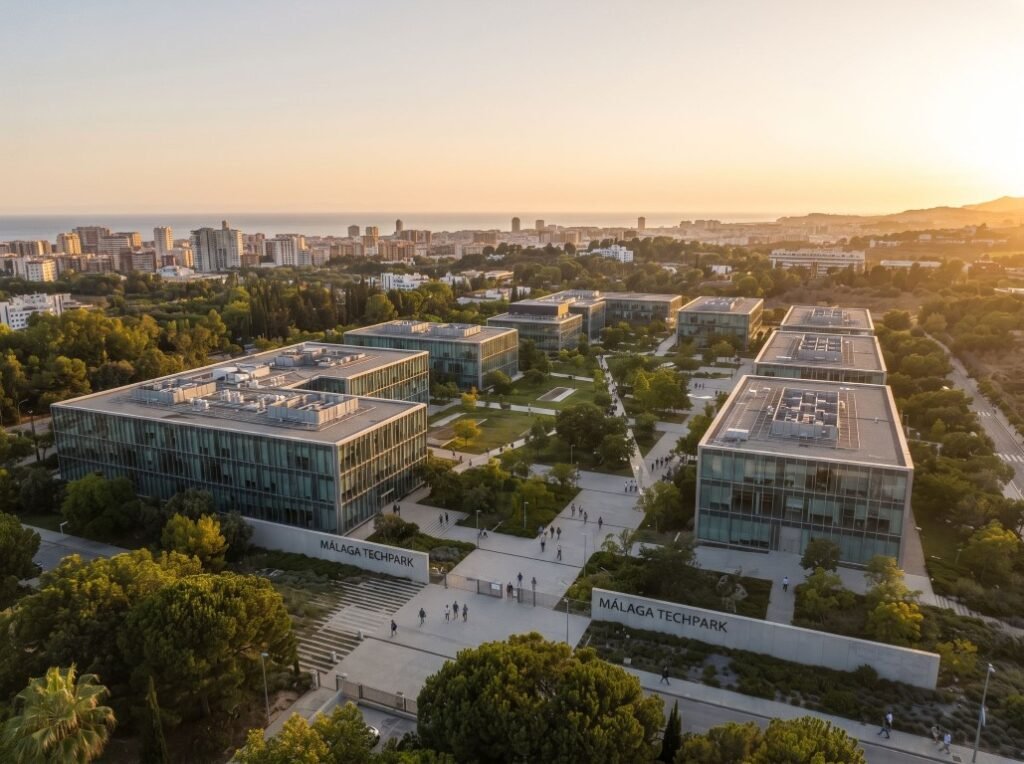
Málaga TechPark now hosts more than 700 companies and close to 28,000 employees, generating well over €4 billion in annual revenue. The roster of international names based there — Google’s cybersecurity centre, Vodafone’s R&D hub, Oracle, Huawei, Accenture and Ericsson among them — has turned what began as a regional experiment into one of southern Europe’s genuine technology clusters, now commonly described as the ‘Silicon Valley of the Mediterranean’.
The Digital Nomad Effect on Housing Demand

This concentration of skilled, well-paid, internationally mobile employment has created a distinct category of property buyer and tenant: remote workers and relocating professionals who want fibre-optic connectivity, proximity to co-working spaces, and an easy commute to Teatinos or the city centre, rather than a beachfront villa an hour’s drive from anywhere. Spain’s Digital Nomad Visa, paired with the favourable Beckham Law tax regime for the first four years of residency, has made Málaga a natural landing point for this group, and rental demand in tech-adjacent neighbourhoods has followed accordingly.
“The buyer profile changing Málaga’s market isn’t retiring to the coast. They’re logging on from it.”
Where the Investment Opportunity Sits
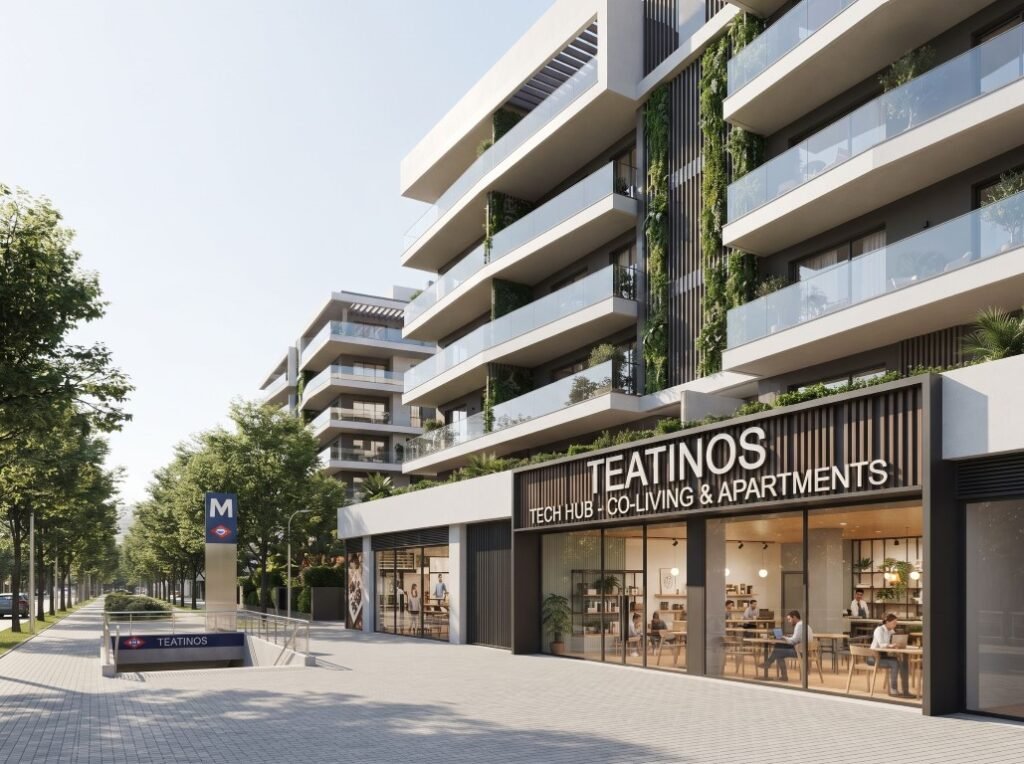
Teatinos, directly connected to the TechPark and the university by metro, has become the clearest beneficiary — new-build apartment stock, rents from around €550 a month for a studio, and consistently strong occupancy from a young, international, well-employed tenant base. City-centre and Soho apartments continue to draw a complementary short-term rental market from business travellers and visiting tech professionals attending the park’s growing calendar of conferences and events.
A Story Still in Its Early Chapters

With expansion plans aiming to double the TechPark’s workforce and further international investment already committed, the demand driving this corner of Málaga’s property market shows every sign of building rather than plateauing — a genuinely different kind of investment case to the tourism-led growth that has traditionally defined the Costa del Sol.
Interested in Málaga’s Tech-Driven Property Market?
We track rental demand and pricing around Málaga’s technology corridor closely and can identify where genuine investment opportunity still exists.
COSTA DEL SOL — INVESTMENT
Málaga Transformed: Why Europe’s Cultural Capital Is Now a Prime Property Destination
our Expert Guide to Living and Investing on the Costa del Sol

Not long ago, Málaga was simply the place your flight landed — the gateway you passed through on the way to Marbella or Estepona, barely worth a second night. That city no longer exists. In its place is a compact, walkable, genuinely cosmopolitan city that residents of Paris, Amsterdam and London now visit deliberately, stay in for a long weekend, and increasingly choose to buy in outright.
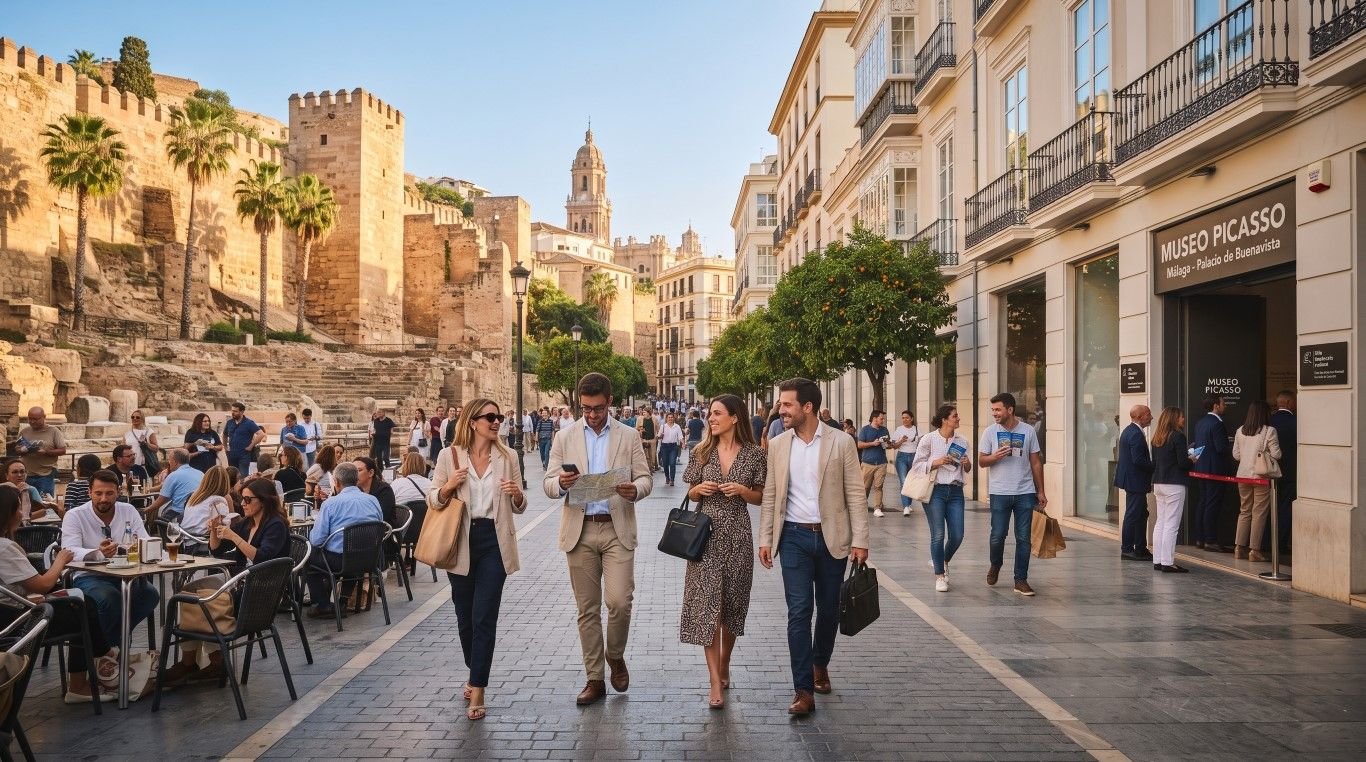
The shift has happened quickly, and it has happened for real reasons — not marketing. Understanding what actually changed helps explain why Málaga city has become one of the most closely watched property markets on the entire Spanish coast.
“Málaga stopped being the gateway to the coast. It became the destination.”
From Gateway to Destination
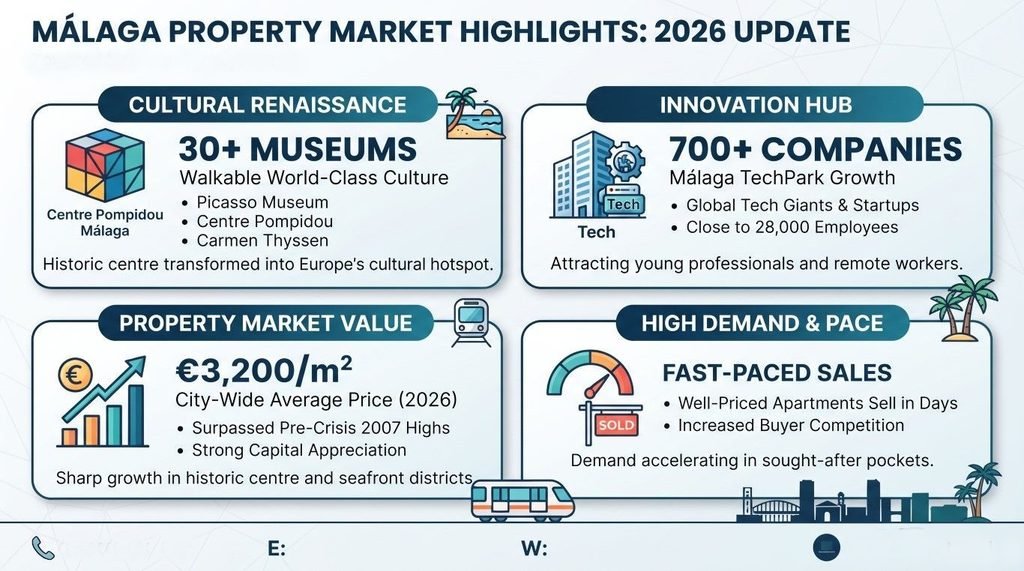
Pablo Picasso was born here, and for decades that fact sat quietly in the background of a city known mainly for its port and its airport. That changed with a deliberate, sustained investment in culture: the Picasso Museum in the historic centre, the Centre Pompidou Málaga — the only outpost of the Paris institution anywhere in the world — the Carmen Thyssen Museum, and a wider push that has given the city more than thirty museums within walking distance of one another. Alongside the culture came infrastructure: a new Metro Line 3, an airport with direct connections to well over a hundred destinations, and a historic centre restored rather than replaced.
A Technology and Talent Magnet
The cultural transformation has run alongside an equally significant economic one. Málaga TechPark now hosts more than 700 companies and close to 28,000 employees, with Google, Vodafone, Oracle and Huawei among the global names that have opened offices in the city. That combination — culture, climate and career opportunity in one place — has pulled in a new resident population of young professionals and remote workers who simply were not part of the city’s story a decade ago.
What This Means for Property Buyers
The property market has responded accordingly. City-wide average prices now sit around €3,200 per square metre in 2026, having surpassed the pre-crisis 2007 highs and continued climbing through 2025 into 2026, with the sharpest growth concentrated in the historic centre, Málaga East and the seafront districts. Well-priced apartments in sought-after pockets now regularly sell within days of listing, a pace that would have been unthinkable in the city just five or six years ago.
“This is no longer a secondary market riding on the coast’s coattails. It has become a destination in its own right.”

Why Buyers Are Choosing Málaga City Over the Coast
For a growing number of our clients, the appeal is specifically urban: the ability to walk to a world-class museum, a Michelin-starred restaurant and the beach within the same afternoon, without needing a car at all. Málaga city offers a genuinely different lifestyle proposition to Marbella or Estepona — denser, more cultural, more connected — and for buyers who want city life with Mediterranean weather attached, it is increasingly the first place they look, not the last.
Thinking About Making the Move?
Our team of specialist advisors has been helping international buyers find their perfect home on the Costa del Sol for 15 years. Whether you are at the early stages of research or ready to view, we would love to hear from you.
T: +34 951 177 422 E: info@mosaicrealty.es W: www.mosaicrealty.es
COSTA DEL SOL — INVESTMENT
Costa del Sol Property Market Outlook: What Savvy Investors Are Watching
Your Expert Guide to Living and Investing on the Costa del Sol

There is a category of property investor who does not follow trends — they anticipate them. They are the buyers who were in Estepona before the town’s renaissance became international news, who recognised La Cala de Mijas before the weekend supplements did, and who understood the significance of Málaga’s technology corridor long before the property prices reflected it. They are the investors who have consistently outperformed the market on the Costa del Sol, not through luck, but through the discipline of watching the right indicators.
This article is written for that kind of buyer — or for those who aspire to think like one. The Costa del Sol’s property market in 2026 offers genuinely compelling opportunities, but it also rewards those who understand its dynamics with some precision. What follows is an honest assessment of the forces shaping the market right now, and where the most sophisticated investors are directing their attention.
The Structural Foundation: Why This Market Is Different
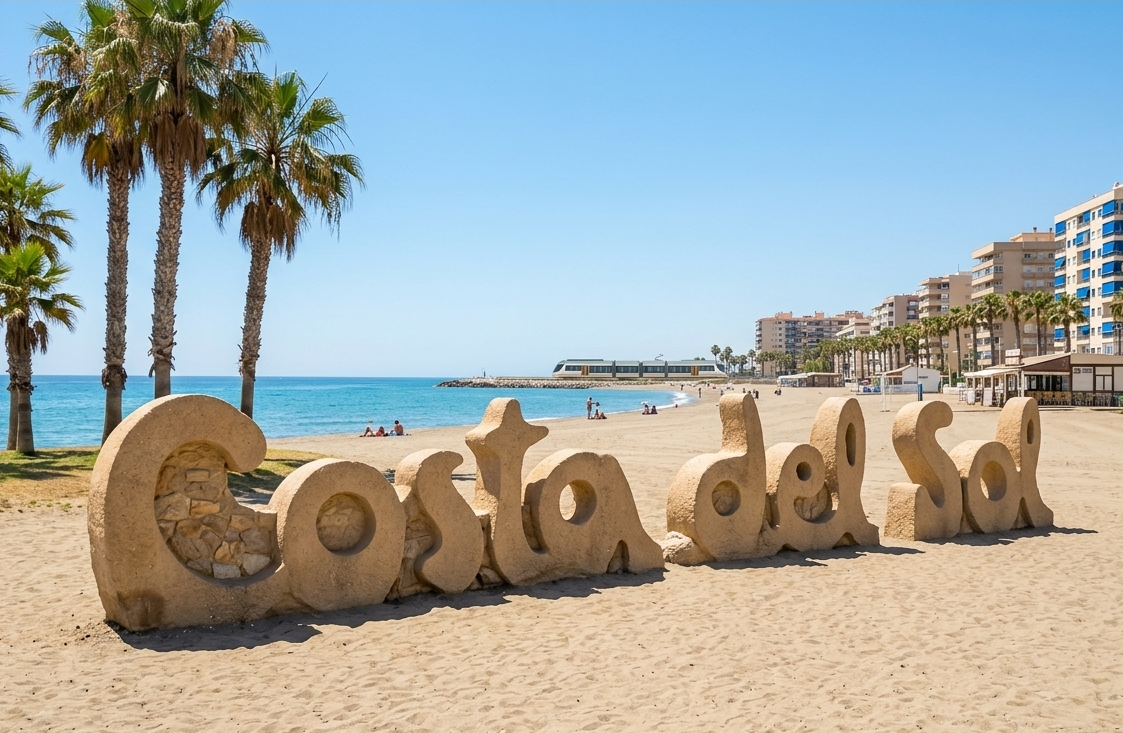
Any serious analysis of the Costa del Sol property market must begin with the fundamentals, because it is the fundamentals that explain the market’s remarkable resilience over time. Unlike markets driven primarily by speculative demand or by the particular conditions of a specific economic cycle, the Costa del Sol is anchored by something far more durable: sustained, structural demand from a large and diverse international buyer base.
The region draws buyers from the UK, Ireland, Scandinavia, the Netherlands, Germany, Belgium, and increasingly from the United States and the Middle East — each motivated by broadly similar factors: climate, lifestyle, quality of healthcare, excellent international connectivity, and a proven track record as both a place to live and a place to invest. This demand is not cyclical. It does not disappear when interest rates rise or when economic confidence softens. It moderates, briefly, and then it returns.
On the supply side, the constraints are structural too. The Costa del Sol’s most desirable locations — first-line beach, elevated sea-view plots, established golf urbanisations with planning and infrastructure already in place — are finite. There is, simply, no more coastline to build on. This supply constraint is the silent engine of the market’s long-term price performance, and it is as relevant in 2026 as it has ever been.
The Málaga Effect: A City That Changes Everything
Perhaps the single most significant development in the Costa del Sol’s property market over the past five years has not happened on the coast at all — it has happened in Málaga city. The arrival of major international technology companies, the expansion of the University of Málaga’s tech and innovation ecosystem, and the city’s growing reputation as one of Europe’s most liveable and culturally vibrant urban centres have created an entirely new demand dynamic for the region.
Málaga is now attracting a profile of buyer — younger, professionally successful, internationally mobile — that the Costa del Sol had not previously seen in significant numbers. These are people who want the lifestyle of the south of Spain, but who also need — or want — proximity to a genuinely international city. They are driving demand not just in Málaga’s premium urban neighbourhoods, but along the entire western corridor of the coast, as the city’s commuter catchment expands.
Investors who understood this shift early — particularly those who positioned themselves in Málaga’s historic centre and eastern waterfront — have seen exceptional returns. The question for 2026 is where the second wave of that effect is headed. The answer, broadly, points west: to the municipalities that offer Málaga’s connectivity with a lower price point and a more expansive lifestyle proposition.
The New Build Premium — and Why It Persists
One of the most consistent features of the Costa del Sol market in recent years has been the premium commanded by quality new-build and off-plan properties — and the persistence of that premium even as overall market conditions have moderated elsewhere in Europe.
The explanation is straightforward. The standard of new-build product available on the Costa del Sol today — in terms of design, specification, sustainability credentials and resort-standard amenities — is simply without precedent in the market’s history. Contemporary buyers, particularly from Northern Europe, have expectations that only new-build can reliably meet: energy efficiency ratings, smart home technology, biophilic design, EV charging infrastructure, and community facilities that can include spas, concierge services and private beach clubs.
Developers have responded to this demand by producing projects at a quality level that continues to attract buyers at prices that reflect that quality. The result is a new-build market where well-positioned developments from credible developers continue to sell — sometimes in their entirety — before a single brick has been laid.
Rental Yields: The Investor’s Secondary Case
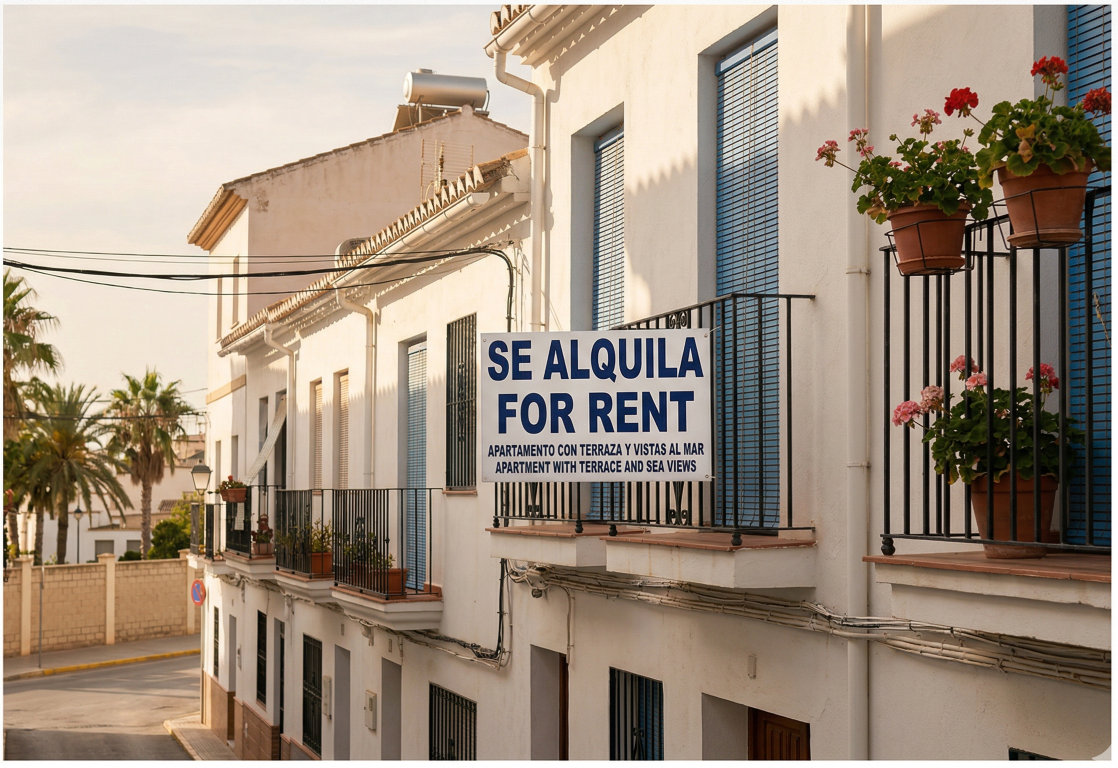
For investors who require their Costa del Sol property to generate income as well as capital appreciation, the rental market provides a compelling secondary case. The region attracted over 13 million tourists in 2024, a number that has grown consistently year on year, driven by Málaga Airport’s expanding route network and the Costa del Sol’s enduring position as one of Europe’s most popular short-break and holiday destinations.
Short-term rental yields in the most sought-after locations — Marbella’s Golden Mile, beachfront Estepona, elevated Benahavis urbanisations — typically range from 5% to 8% gross, depending on the property type, location and level of management. Well-presented, well-located properties let through professional management companies consistently achieve high occupancy rates through extended seasons that now run from March to November.
The regulatory environment for tourist rentals in Andalucía is evolving, and investors should take independent advice on the licensing requirements applicable to their specific municipality. The broad principle, however, is that well-regulated short-term rental markets provide more stability, not less, for serious operators.
Where Savvy Investors Are Looking in 2026
The honest answer is that the most sophisticated investors we work with are not all looking in the same place — because their objectives differ. Those seeking maximum capital growth over a five to ten year horizon are focused on the emerging municipalities: Casares, Manilva and the western corridor beyond Estepona, where land values remain relatively accessible and the infrastructure investment now underway will, in time, drive significant appreciation.
Those seeking a blend of lifestyle and yield are focused on La Cala de Mijas, Fuengirola and Benalmádena — established communities with strong rental demand, year-round resident populations, and a quality-of-life proposition that attracts both long-term tenants and short-term visitors.
Those at the very top of the market — seeking trophy assets, privacy and the certainty of enduring prestige value — remain focused on Benahavis, Sierra Blanca, and Marbella’s Golden Mile. These markets move slowly, but they move in one direction only.
The Interest Rate Tailwind
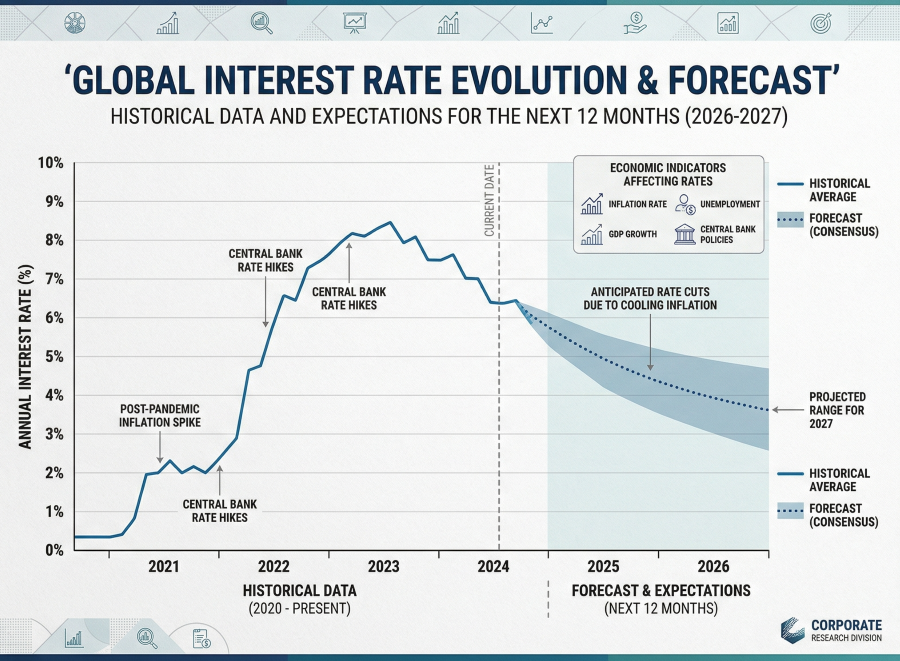
After a period of elevated interest rates that moderated buyer activity in 2023 and into 2024, the trajectory of European monetary policy is now providing a meaningful tailwind for the Costa del Sol market. The European Central Bank’s easing cycle — which began in 2024 and continued through 2025 — has improved mortgage affordability for both resident and non-resident buyers, and renewed confidence among buyers who had been waiting for clearer conditions.
The buyers who acted during the higher-rate period, when competition was slightly less fierce and developers were more willing to negotiate, have already seen the benefit. Those looking at the market now will find conditions that are more competitive — but also, in a falling-rate environment, financing that is increasingly attractive.
Our Considered View
We do not deal in predictions, and we would not advise any investor to make a decision based on a single market commentary. What we do offer is the perspective of a team that lives and works in this market every day — that sees the transactions, watches the demand, and understands the micro-dynamics of individual locations that no macro analysis can fully capture.
Our considered view is this: the Costa del Sol in 2026 offers a more nuanced set of opportunities than a headline view of the market suggests. The simple observation that prices have risen significantly over recent years is true — but it obscures the variation between locations, property types and quality tiers that creates genuine opportunity for the well-informed buyer.
The market rewards specificity. Knowing which municipality is in the early stages of a value uplift, which developer has a track record of delivery, which location offers the best balance of lifestyle and yield for a particular buyer’s profile — this is where the value lies. And this is precisely the kind of knowledge that our team is here to share.
Thinking About Making the Move?
Our team of specialist advisors has been helping international buyers find their perfect home on the Costa del Sol for 15 years. Whether you are at the early stages of research or ready to view, we would love to hear from you.
T: +34 951 177 422 E: info@mosaicrealty.es W: www.mosaicrealty.es
COSTA DEL SOL — LIFESTYLE & AREA GUIDE
Why the Costa del Sol Remains Europe’s Most Coveted Address in 2026
Your Expert Guide to Living and Investing on the Costa del Sol

There is a moment, somewhere between your first glimpse of the Mediterranean and the warmth of the Andalusian sun on your face, when the Costa del Sol stops feeling like a holiday destination and starts feeling like home. It is a feeling that has drawn discerning buyers from across Europe, the UK, Scandinavia and beyond for decades — and in 2026, that feeling is stronger than ever.
But what is it, precisely, that keeps the Costa del Sol at the very top of Europe’s most sought-after property markets? What sustains demand year after year, through economic cycles and shifting global trends, in a way that few other destinations can match? The answer, as with everything on this extraordinary stretch of Andalusian coastline, is layered, compelling and deeply personal.
“The Costa del Sol doesn’t just offer a property. It offers an entirely different relationship with life.”
An Unrivalled Quality of Life

At its core, the enduring appeal of the Costa del Sol is an appeal to lifestyle. Over 320 days of sunshine per year. A coastline stretching more than 150 kilometres from the cliffs of Nerja in the east to the hills of Manilva in the west. World-class golf courses — over 70 at last count — drawing players from every corner of the globe. Michelin-starred restaurants sitting comfortably alongside family-run chiringuitos on the beach. A culture that celebrates the art of living well.
This is not a lifestyle that requires compromise. Families relocating from London, Dublin, Stockholm or Amsterdam find international schools of the highest calibre. Healthcare facilities across the region — both public and private — are modern, accessible and well-regarded. Transport links, anchored by Málaga’s Costa del Sol Airport, now serve more European destinations than ever before, making the commute between your Spanish home and your northern European life not merely manageable, but genuinely straightforward.
A Property Market That Rewards Confidence

For investors, the Costa del Sol’s credentials in 2026 remain as robust as they have ever been. Property values across the region have demonstrated the kind of resilience that comes not from speculation, but from the fundamentals: sustained international demand, a constrained supply of well-positioned stock, and a consistently strong rental market driven by one of Europe’s most popular tourist destinations.
The premium end of the market — new-build villas and boutique apartments in locations such as Benahavís, La Cala de Mijas, and Estepona’s western corridor — continues to attract buyers for whom quality, privacy and long-term value are non-negotiable. Meanwhile, established towns like Fuengirola, Torremolinos and Benalmádena offer a compelling case for those seeking strong rental yields alongside a vibrant year-round community.
The arrival of major technology companies and international businesses to Málaga city has added a further dimension to the market, bringing with it a new wave of professional buyers and a demand for premium urban living that has reinvigorated the city’s property landscape.
“In a world of uncertainty, the Costa del Sol offers something increasingly rare: the certainty of a life genuinely well-lived.”
The Off-Plan Revolution
Perhaps nowhere is the confidence in the Costa del Sol’s future more visible than in the wave of exceptional new developments that have transformed the region’s skyline in recent years. From architecturally striking hilltop villas in Mijas to elegantly curated beachfront apartments in Estepona, the quality of new-build product available to today’s buyer is at a level the market has simply never seen before.
Sustainability, smart-home technology, biophilic design and resort-standard amenities are no longer the preserve of trophy properties — they are the benchmark. Developers across the Costa del Sol have responded to the expectations of an increasingly sophisticated international buyer, and the result is a pipeline of projects that genuinely excites even the most experienced property investor.
Beyond the Coastline: A Region of Extraordinary Depth
To think of the Costa del Sol purely in terms of beaches and golf courses is to underestimate it considerably. This is a region of remarkable cultural richness: the museums and galleries of Málaga, the whitewashed mountain villages of the interior, the vibrant flamenco traditions of Andalusia, the ancient history that layers itself across every town and hillside.
Expats who choose to make their lives here quickly discover that the Costa del Sol rewards curiosity. Every weekend offers something new — a village festival, a local market, a drive through the Sierra de las Nieves, an afternoon in the medina of Marbella’s old town. The region does not simply provide a backdrop for your life; it becomes an active and endlessly engaging part of it.
The Community You Have Always Wanted
One of the least-discussed but most powerful draws of the Costa del Sol is the quality of the international community that has made its home here. Across every town and urbanisation, you will find people who have made the same choice you are considering — who have traded grey skies and long commutes for a life of warmth, colour and connection. The social fabric of the coast is rich, welcoming and genuinely international, with British, Irish, Scandinavian, German and Dutch communities well-established and thriving alongside the Spanish residents who give the region its authentic soul.
It is a community built not around proximity, but around a shared understanding that life is too short and too precious to be lived anywhere but here.
2026: The Moment to Act
The question we are asked most often by prospective buyers is whether now is the right time. In our experience, that question, while entirely understandable, slightly misses the point. The Costa del Sol has rewarded buyers who acted with conviction in every decade and in every market condition. The region’s fundamentals — its climate, its infrastructure, its culture, its community — do not change with the economic cycle.
What does change is the availability of the finest properties. The most desirable homes — the sea-view villas, the first-line beach apartments, the off-plan launches in the most coveted locations — do not wait. They are claimed, quietly and swiftly, by buyers who have done their research, trusted their instincts, and understood that on the Costa del Sol, the opportunity cost of hesitation is always higher than the cost of acting.
In 2026, with new development of the highest quality coming to market, with infrastructure investment continuing to strengthen connectivity across the region, and with international buyer demand showing no sign of abating, the Costa del Sol makes its case as compellingly as it ever has.
“The Costa del Sol has been Europe’s most coveted address for a generation. The reasons why have never been stronger.”
Thinking About Making the Move?
Our team of specialist advisors has been helping international buyers find their perfect home on the Costa del Sol for 15 years. Whether you are at the early stages of research or ready to view, we would love to hear from you.
T: +34 951 177 422 E: info@mosaicrealty.es W: www.mosaicrealty.es