

Category: Buying guides
As new-build specialists on the Costa del Sol, we see many buyers purchase off-plan. In practice, that means paying a reservation fee and then a series of stage payments to the developer before your keys exist. It is a well-established way to buy, often at launch prices and with a choice of unit, but it is natural to ask what happens to that money if the project stalls.
Spanish law has a clear answer. And three Supreme Court rulings in 2026 have added useful detail, including one won by a British buyer.
What Spanish law requires of developers
Since 1 January 2016, the rules have been in the first additional provision of Spain’s Building Act, the Ley 38/1999 de Ordenación de la Edificación, as amended by Law 20/2015. They replaced the older Law 57/1968, which still governs many contracts signed before 2016.
According to the Banco de España’s guide for bank customers, the key points are:
- Once the building licence is granted, the developer must guarantee every payment you make in advance, through either an insurance policy that names you as beneficiary or a bank guarantee (aval).
- The guarantee covers everything you have paid, including taxes, plus statutory interest from the date of each payment to the agreed delivery date.
- Payments should go into a special account linked to the development.
- The guarantee stays in force until the first-occupation licence (or equivalent) is issued and the home is handed over to you.
How a claim works
If building work doesn’t start, or the home isn’t finished by the agreed date, you can cancel the contract and ask the developer for your money back. If the developer hasn’t repaid you within 30 days, you can claim directly from the insurer or bank that issued the guarantee.
One deadline matters a great deal. The Banco de España notes that the guarantee lapses if two years pass after the developer’s breach without you having asked to cancel and be repaid. If a delivery date slips, keep that two-year window in mind and take legal advice early rather than late.
What the Supreme Court said in 2026
Three rulings this year show how the courts apply these rules, especially when a bank received the buyer’s money but never issued a guarantee itself.
A British buyer recovers over €160,000. In ruling 443/2026 of 23 March, the Supreme Court held Banco Santander liable for money a British buyer paid in 2005 towards a development that was never built. The bank argued that he was an investor rather than a home buyer. The court found no real evidence of that and confirmed the bank’s duty to control the advance payments it received.
Payment details decide cases. As Moncloa.com reports, in the Santander case the transfer receipt named the buyer, the development and the apartment number. That was enough for the bank to know the money was an off-plan deposit. In two other rulings (586/2026 involving Cajamar and 738/2026 involving CaixaBank), buyers lost against the bank. Their deposits carried no identifying details, or arrived as one combined cheque from intermediaries, so the bank couldn’t reasonably have linked them to individual home purchases.
Holiday homes count, speculation doesn’t. In ruling 722/2026 of 11 May, the court confirmed that the protection covers a main home, a second home or a holiday home. Purchases made purely to invest or resell can fall outside it. Warning signs included owning other properties, contracts that let buyers sell on their position, and no explanation of what the homes were for.
These cases concern contracts signed under the old 1968 law. As Alicante Plaza points out, the current regime differs in some respects (for example, the obligation is tied to the building licence), so the rulings aren’t a template for every modern case. The practical lessons still apply, though.
A checklist before you pay a deposit
- Ask for the guarantee in writing. For each stage payment you should receive an individual insurance or bank guarantee certificate in your name, covering the full amount including VAT.
- Check who is guaranteeing you. It should be a Spanish-authorised bank or insurer, and your lawyer can confirm the document is genuine.
- Pay into the account named in the contract. Use the special account for the development, never a personal or third-party account.
- Reference every transfer clearly. Include your name, the development and the unit number. The 2026 rulings show how much this detail can matter.
- Avoid pooled payments. Don’t pay through intermediaries who combine several buyers’ money into one transfer.
- Keep records. Keep contracts, receipts, guarantee certificates and any correspondence with the bank.
- Note the delivery date. Know the agreed delivery date and what the contract says about delays, and remember the two-year window.
- Use your own independent lawyer. They should check the building licence and the guarantees before you sign.
If you’re also weighing up tax, timelines and running costs, our guide to buying in Spain walks through the whole process. You can browse current off-plan and new-build homes on our new developments page.
Buying off-plan with confidence
Off-plan buying on the Costa del Sol is well regulated, and a properly guaranteed deposit is protected by law. The buyers who come unstuck are usually those whose payments can’t be traced or whose guarantees were never checked. A Mosaic advisor can talk you through how payments are structured on any development we show you, or you can download our free 2026 Buyers Guide for a step-by-step overview.
This article is general information, not legal advice. Always take advice from an independent Spanish lawyer before signing or paying.
Sources
- Ley 38/1999, de 5 de noviembre, de Ordenación de la Edificación – BOE
- Garantía de devolución de cantidades entregadas a cuenta – Banco de España, Portal del Cliente Bancario
- Comprar sobre plano: el Supremo aclara quién puede reclamar al banco las cantidades anticipadas – idealista/news, 15 June 2026
- La Sala Primera del Tribunal Supremo fija la responsabilidad bancaria en vivienda sobre plano en tres sentencias de 2026 – Moncloa.com, 12 August 2026
- Garantías en obra nueva: lo que la STS 443/2026 recuerda a promotores y agentes – Alicante Plaza, 28 June 2026
COSTA DEL SOL — INVESTMENT
The Hidden Costs of Buying Property in Spain — And How to Plan for Them
our Expert Guide to Living and Investing on the Costa del Sol


It begins with a number. A property you have been thinking about for months — perhaps a two-bedroom apartment in a new development above Mijas, or a resale villa with sea views near Fuengirola — carries a price tag that fits your budget with a little room to spare. You feel comfortable. You feel ready. And then your lawyer sends over a comprehensive cost breakdown, and the number is suddenly, disconcertingly, larger than you expected.
This is one of the most common experiences international buyers have in the Spanish property market — not because the costs are hidden in any dishonest sense, but because the Spanish system places the majority of transaction taxes and fees on the buyer rather than the seller, and those costs are rarely shown front and centre on a property listing. Understanding them in advance is not just sensible — it is essential. Failing to budget accurately for the true cost of acquisition is one of the primary causes of deal failures, delayed completions and genuine financial stress among buyers who arrived on the Costa del Sol with every intention of making a smooth and considered purchase.
The good news is that these costs are, for the most part, entirely predictable. They are set by law or regional decree. There are no surprises if you know where to look — and knowing where to look is precisely what this article is designed to help you do.
“Budget an additional ten to fourteen percent on top of the purchase price. Everything else flows from getting that number right.”
The Purchase Tax: Your Largest Additional Cost
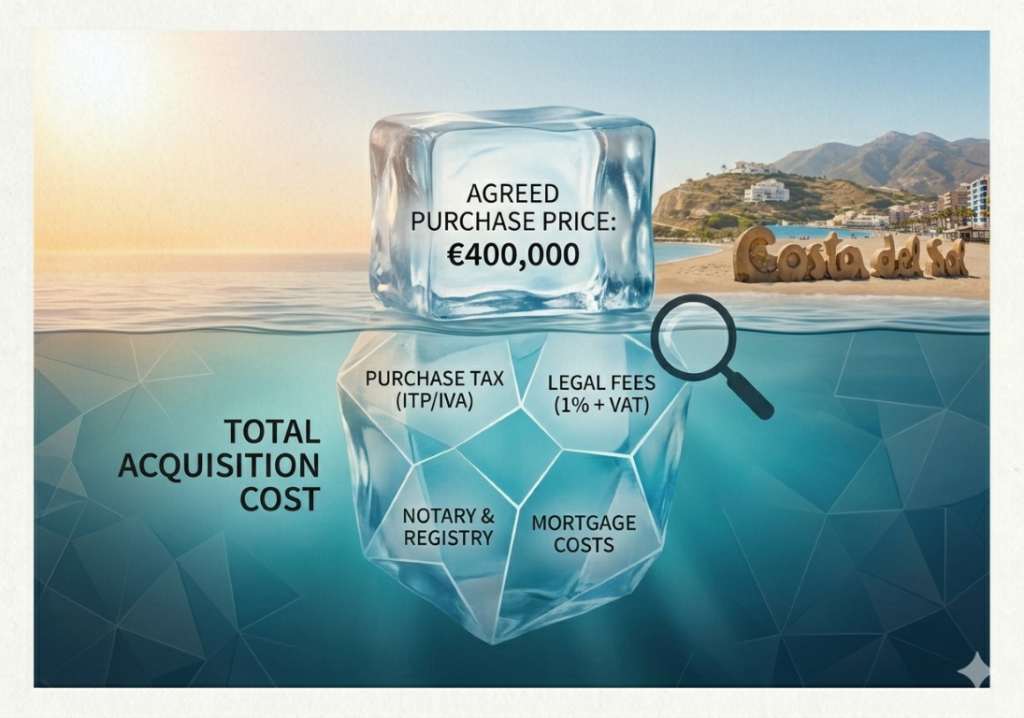
The single largest cost beyond the agreed purchase price is the purchase tax, and the rate you pay depends entirely on whether you are buying a new build or a resale property.
For resale properties in Andalucía — which covers the entire Costa del Sol — the applicable tax is the Impuesto sobre Transmisiones Patrimoniales (ITP), the Property Transfer Tax. The rate in Andalucía is seven percent of the purchase price, which compares favourably with other Spanish regions: in Catalonia, for example, the same tax is ten percent, and in Valencia it has recently been reduced from ten to nine percent. On a €400,000 property on the Costa del Sol, this represents a €28,000 tax bill — and it must be paid within thirty business days of signing the deed at the notary, before the property can be registered in your name.
For new-build properties purchased directly from a developer, the tax structure is different. Instead of ITP, buyers pay VAT (IVA in Spain) at ten percent of the purchase price, plus a stamp duty charge known as Actos Jurídicos Documentados (AJD) of approximately 1.2 percent in Andalucía. On that same €400,000 new build, the tax bill comes to approximately €44,800 — meaningfully higher than the resale equivalent. This difference is a genuine financial consideration when comparing equivalent properties across both categories.
It is also worth noting that Spanish tax authorities now calculate purchase tax on the higher of two values: the agreed purchase price, or the Valor de Referencia — a cadastral reference value determined by the Spanish tax office. In most cases on the Costa del Sol, the purchase price exceeds the reference value, so this has little practical impact. However, buyers purchasing at what they believe to be a discounted price should be aware that the tax calculation may not reflect any discount negotiated below the market reference value.
Legal, Notary and Registry Fees
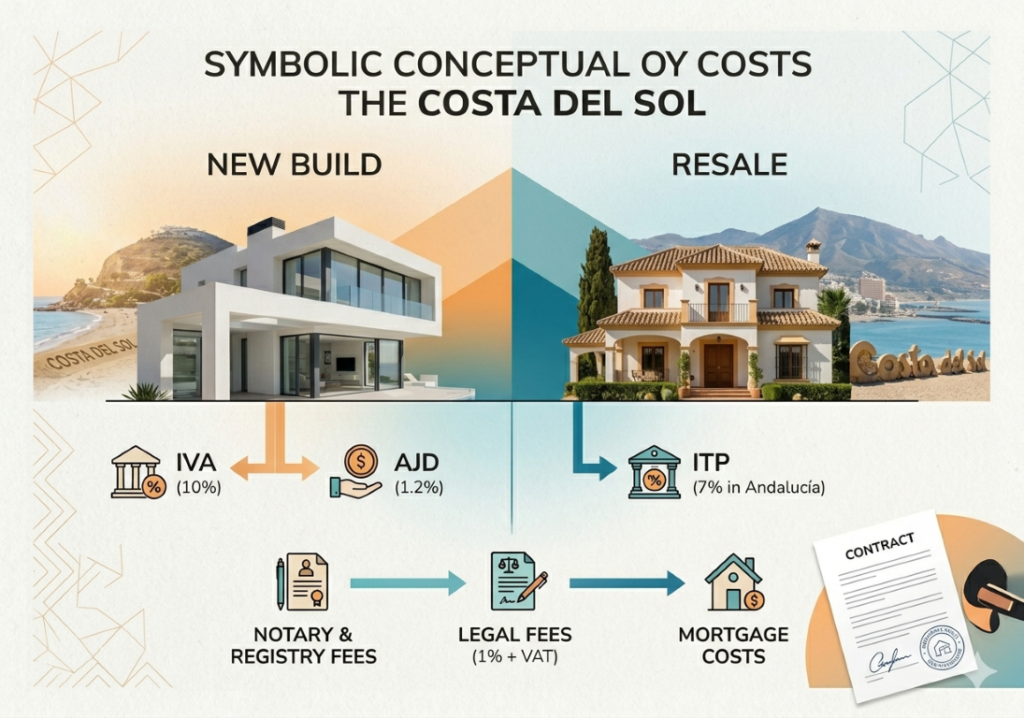
Beyond the purchase tax, every property transaction in Spain requires three additional layers of professional cost, all of which are mandatory.
Notary fees are regulated by law on a sliding scale based on the purchase price and the complexity of the deed. For a typical residential transaction on the Costa del Sol, budget between €800 and €1,500. Once the deed is signed at the notary, it must be inscribed at the Land Registry (Registro de la Propiedad), with associated fees of approximately €400 to €800 depending on the property value.
Legal fees represent the cost most buyers are aware of but sometimes underestimate. While engaging a Spanish property lawyer is not legally mandatory, for any international buyer it is absolutely non-negotiable. A good property lawyer will check the property for outstanding debts and charges, verify that planning permissions are in order, confirm the property is correctly registered, arrange your NIE number (the tax identification number required for all Spanish property transactions) and represent you at the notary. Standard legal fees run at approximately one percent of the purchase price plus 21 percent VAT — on a €400,000 purchase, that is €4,840 all-in. Some firms offer fixed fees for simpler transactions, which can represent a saving at higher price points.
Mortgage Costs: What You Pay, What the Bank Pays
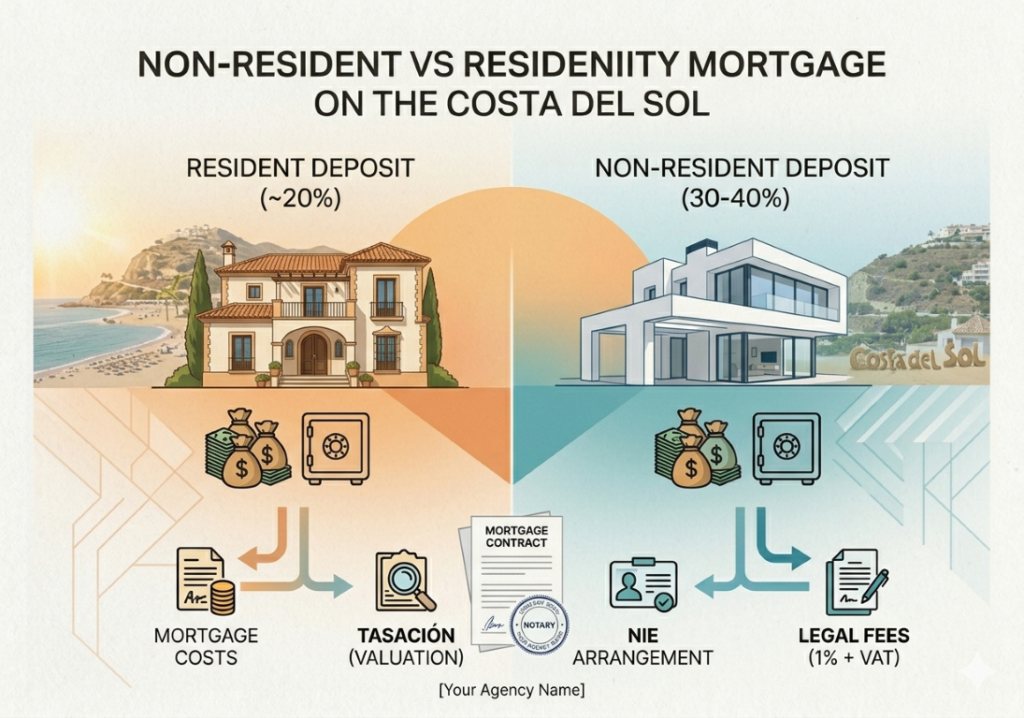
If you are financing your purchase with a Spanish mortgage, the 2019 Mortgage Law Reform significantly improved the position for borrowers: banks now cover the notary and registry costs associated with the mortgage deed itself, the mortgage tax, and their own arrangement costs. As a buyer, you are left responsible for two items: the mandatory property valuation (tasación), which costs approximately €400 to €700 depending on the property and the lender, and any bank arrangement fee if applicable — though many lenders on the Costa del Sol have removed this charge for competitive reasons.
Non-resident buyers should also be aware that Spanish banks typically require a deposit of thirty to forty percent of the purchase price (compared to approximately twenty percent for Spanish fiscal residents), and that these funds need to be available in addition to, not as part of, the budget for taxes and fees. For a €500,000 property, a non-resident should realistically have €250,000 to €285,000 in accessible funds — covering the deposit, purchase taxes and all professional fees.
“The costs are not hidden. They are simply rarely explained. Knowing them in advance transforms a stressful surprise into a straightforward budget line.”
The Ongoing Costs: What Owning Costs You Each Year
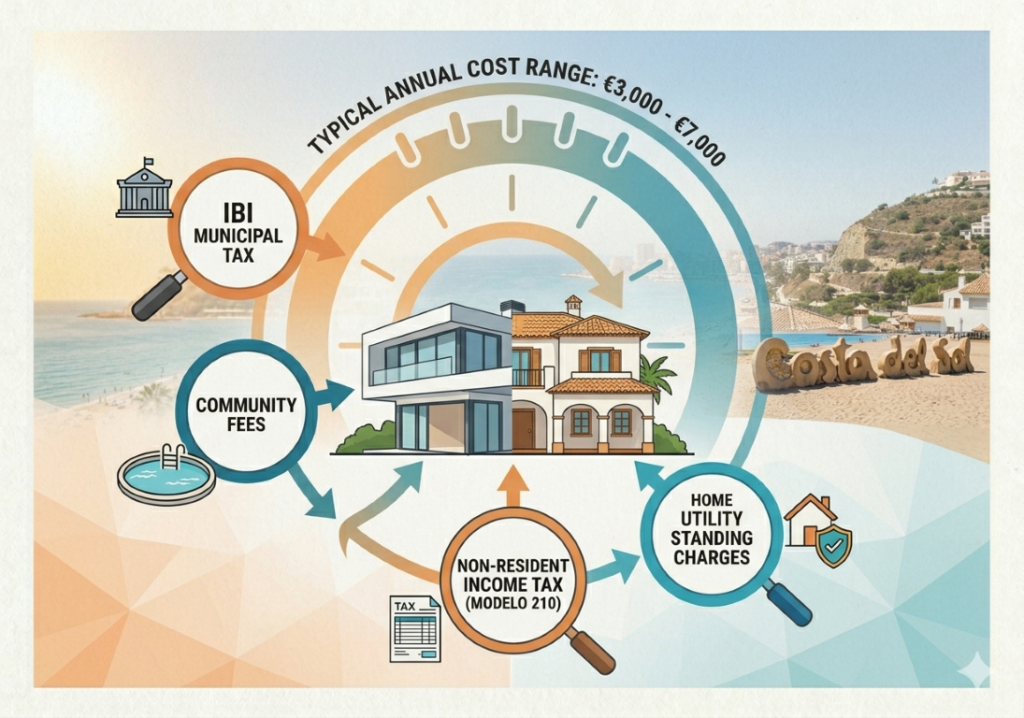
Beyond the one-time acquisition costs, owning property on the Costa del Sol as a non-resident carries a set of predictable annual obligations that buyers frequently overlook until they receive their first year’s bills.
The IBI (Impuesto sobre Bienes Inmuebles) is the annual municipal property tax, calculated on the cadastral value of the property. For most Costa del Sol properties, this runs between €300 and €1,500 per year, though larger or higher-value properties will sit towards the upper end of that range.
Community fees apply to any property within a residential complex or urbanisation with shared amenities — which describes the vast majority of new-build developments on the Costa del Sol. Expect to budget €100 to €500 per month depending on the facilities provided; luxury developments with pools, gyms, security and landscaped gardens naturally command higher fees but also typically support stronger rental yields.
Non-resident income tax is perhaps the most frequently overlooked obligation. Under Spanish law, non-resident property owners must file an annual tax return (Modelo 210) regardless of whether they rent the property out or not. For an unrented property, the tax is calculated as 1.1 percent of the cadastral value, taxed at 19 percent for EU/EEA residents or 19 percent for non-EU residents following a landmark 2025 ruling by Spain’s National Court that aligned the rates for non-EU owners. For most Costa del Sol properties, this represents an annual obligation of between €300 and €800.
Home insurance (€200 to €600 per year), utility standing charges and, for those purchasing for rental purposes, a property management fee of eight to fifteen percent of rental income complete the picture. Taking all of these into account, annual ownership costs for a non-resident on a mid-market Costa del Sol property typically run between €3,000 and €7,000 per year before any mortgage payments.
The Andalucía Advantage
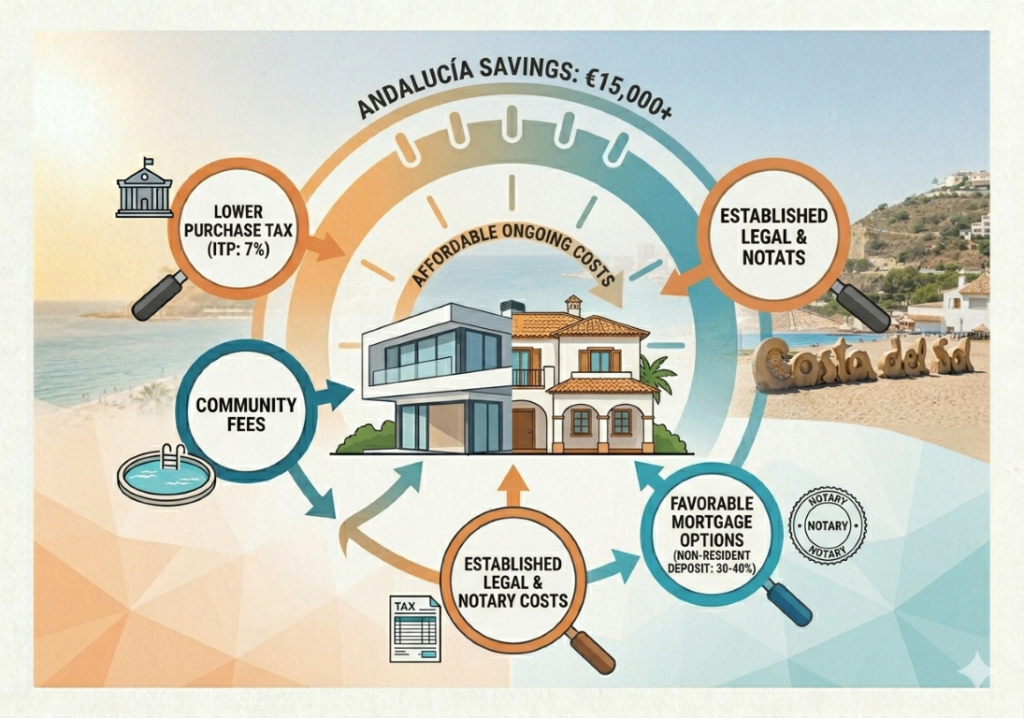
One point that is worth underscoring for buyers comparing the Costa del Sol with other Spanish regions: Andalucía is one of the most cost-effective regions in Spain in which to buy property. The seven percent ITP on resale properties compares favourably with rates of up to ten percent in other autonomous communities. On a €500,000 purchase, that difference alone amounts to €15,000 — a saving that can meaningfully offset legal and professional fees.
None of these costs should deter a buyer who has done their research and budgeted correctly. The Costa del Sol’s property market continues to offer a combination of lifestyle, climate, rental yield and long-term capital appreciation that justifies every line of the cost table. The key is simply to know those lines before you make your offer, not after you have committed to a purchase price that leaves no room for the reality of acquisition costs in Spain.
Thinking About Making the Move?
Our team of specialist advisors has been helping international buyers find their perfect home on the Costa del Sol for 15 years. Whether you are at the early stages of research or ready to view, we would love to hear from you.
T: +34 951 177 422 E: info@mosaicrealty.es W: www.mosaicrealty.es
COSTA DEL SOL — INVESTMENT
New Build vs Resale on the Costa del Sol: Which Is Right for You?
our Expert Guide to Living and Investing on the Costa del Sol

There is a moment, familiar to almost every buyer who has seriously explored the Costa del Sol property market, when the question shifts from ‘where’ to ‘what’. You have fallen for the light, the lifestyle, the landscape. You have chosen your town, perhaps even your preferred street. And then the real decision arrives: do you buy new, or do you buy resale? It is a question that sounds straightforward but rarely is — and getting it right can mean the difference between a purchase that serves you perfectly for decades and one that quietly underdelivers from the day you collect the keys.
The Costa del Sol in 2026 presents both options in abundance and at quality levels the market has rarely seen. Average property prices in prime locations now range from €3,500 to €6,000 per square metre in established areas such as Fuengirola, Mijas Costa and Benalmádena, rising to €5,500–€10,000 per square metre in Marbella and its surrounding municipalities. Knowing which route to take — and why — requires an honest look at what each genuinely offers.
“The decision is not new build versus resale. It is about aligning the right property with the right life.”
The Case for New Build

New-build properties on the Costa del Sol have never been more compelling. The quality of construction, specification and design has advanced dramatically over the past decade, driven by an increasingly sophisticated international buyer who expects — and receives — considerably more than a blank white box. Smart home technology, A-rated energy performance, premium Italian kitchens, floor-to-ceiling glazing, underfloor heating and resort-standard communal facilities are now commonplace across developments at virtually every price point.
From a financial perspective, the new-build route carries several structural advantages. Every new development purchased directly from a developer comes with a ten-year structural warranty, providing significant peace of mind and a clear framework for any defect resolution. Running costs are materially lower: energy-efficient construction and modern insulation mean utility bills that can be a fraction of those associated with older properties. And crucially, the best developers on the Costa del Sol are increasingly building in locations — elevated hillside plots, gated communities with panoramic sea views — that were historically the preserve of bespoke villa projects.
Off-plan purchases, which represent the majority of new-build transactions, also allow buyers to secure at today’s prices with completion eighteen to thirty months away — a strategy that has rewarded buyers consistently on the Costa del Sol, where prices have risen by seven to ten percent annually in recent years. Phase-one pricing on quality schemes frequently sits below what comparable completed stock commands, and the ability to customise finishes adds a further dimension of value.
The tax structure for new builds in Andalucía is clear: buyers pay ten percent VAT plus stamp duty (AJD) of approximately 1.2 percent, making total acquisition costs broadly predictable at twelve to fourteen percent of the purchase price on top of the agreed figure.
The Case for Resale

Resale property makes its own compelling argument, and for a significant proportion of buyers, it remains the more practical and satisfying choice. The most fundamental advantage is immediacy: you can see exactly what you are buying, move in on completion, and begin enjoying your investment from the moment you collect the keys. There is no construction risk, no phase delivery uncertainty and no waiting period during which your plans may change.
Location is perhaps the most powerful argument in resale’s favour. The best-positioned properties — those on established urbanisations with direct beach access, walking distance to village centres, or genuinely first-line sea views — are rarely reproduced in new developments, simply because the land is no longer available. Buyers seeking a property that sits within an established, walkable community, with mature gardens and the authentic character of a lived-in neighbourhood, will almost always find that character in resale stock.
Pricing can also favour resale, particularly in the mid-market. Well-presented resale properties in Fuengirola, Benalmádena and Mijas Costa often offer more internal space per euro spent than equivalent new builds, and motivated vendors on the resale market will negotiate in ways that developers with strong forward sales pipelines generally will not. For buyers who intend to renovate, there is an additional opportunity: purchasing below market value and upgrading to a high specification can create meaningful equity in a short timeframe.
The tax position on resale is equally straightforward: in Andalucía, buyers pay a property transfer tax (ITP) of seven percent. Combined with legal, notary and registry fees, total acquisition costs for resale properties typically land between ten and thirteen percent of the purchase price — slightly lower than new build in most scenarios, which is a meaningful consideration on higher-value transactions.
“On the Costa del Sol, the best purchases are not defined by whether they are new or resale, but by how well they align with scarcity, quality, and the buyer’s real life five years on.”
The Decision Framework

The honest answer is that neither category is universally superior — and any advisor who tells you otherwise is selling you a preference, not a strategy. The right choice depends on four factors: your timeline, your budget including all acquisition costs, your lifestyle priorities, and your investment objectives.
If you are planning a primary or year-round residence and value community, character and location above all else, resale is likely to serve you better. If you are purchasing as an investment or second home and your priorities are energy efficiency, modern specification, strong rental yield potential and long-term capital appreciation, new build presents a compelling case. If you are somewhere in between — which describes the majority of our buyers — the answer lies in looking carefully at both, with an experienced agent who knows the micro-markets well enough to compare genuinely comparable options across categories.
What the Costa del Sol’s 2026 market makes clear is that quality is available on both sides of the argument. The region’s structural advantages — sustained international demand, constrained land supply, over 320 days of sunshine per year, outstanding infrastructure and a lifestyle offer that simply cannot be replicated elsewhere in Europe — make this one of the few markets in the world where the question of new build versus resale is genuinely secondary to the question of acting with conviction and making the right choice for your circumstances.
Thinking About Making the Move?
Our team of specialist advisors has been helping international buyers find their perfect home on the Costa del Sol for 15 years. Whether you are at the early stages of research or ready to view, we would love to hear from you.
T: +34 951 177 422 E: info@mosaicrealty.es W: www.mosaicrealty.es
COSTA DEL SOL — INVESTMENT
How to Secure a Spanish Mortgage as a Non-Resident Buyer
our Expert Guide to Living and Investing on the Costa del Sol

For many buyers approaching the Costa del Sol property market from the UK, Ireland or Scandinavia, the assumption is that financing a Spanish purchase will be complicated, slow and probably not worth the effort. It is an assumption that costs more people more opportunities than almost any other misconception in the market. The truth is that Spanish banks actively lend to non-resident foreign buyers, the process — while different from what you may be used to at home — is well-established and clearly structured, and in 2026, with Euribor having fallen steadily from its 2023 peak of 4.16 percent to approximately 2.43 percent, mortgage rates for non-residents are considerably more attractive than they were just two years ago.
Understanding how the Spanish mortgage market works — its rules, its terminology and its requirements — is the single most powerful thing a prospective buyer can do before beginning their property search in earnest. The buyers who move quickly and confidently when the right property appears are almost always the ones who have done this preparation. Those who have not are the ones who lose properties to buyers who have.
“The buyers who secure the best properties on the Costa del Sol are the ones who have their financing ready before they start looking.”
What Spanish Banks Will Lend You
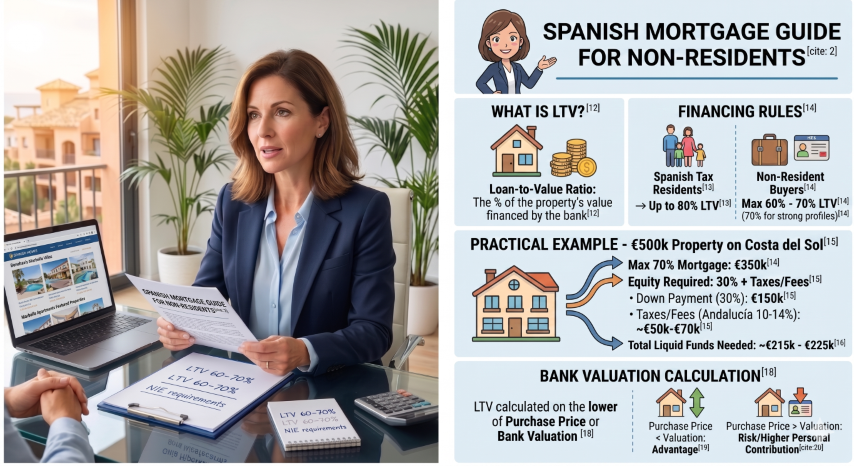
The starting point for any non-resident mortgage conversation is the loan-to-value (LTV) ratio — the percentage of the property’s value that a Spanish bank will finance. The rules here are clear and consistent: Spanish fiscal residents purchasing a primary residence can typically borrow up to eighty percent of the property’s appraised value. Non-resident buyers — defined as those who spend fewer than 183 days per year in Spain and pay their primary taxes outside the country — are offered a maximum of sixty to seventy percent LTV, with seventy percent available to buyers with strong financial profiles and clean credit histories.
In practical terms, this means that a non-resident buyer purchasing a €500,000 property on the Costa del Sol should plan to fund the remaining thirty to forty percent from their own resources — €150,000 to €200,000 — plus the full cost of taxes and professional fees, which in Andalucía typically run to ten to fourteen percent of the purchase price. On that same €500,000 purchase, a buyer at maximum LTV needs approximately €215,000 to €225,000 in liquid funds to complete the transaction comfortably. Having this number clearly in mind from the outset prevents the disappointment of finding the right property only to discover the financing does not stack.
Spanish banks calculate LTV on the lower of the agreed purchase price or the official bank valuation (tasación). If a property is being sold below its appraised value, the bank may lend against the higher valuation figure, which is a genuine advantage for buyers who negotiate well. Conversely, if the purchase price exceeds the valuation, the buyer must fund the difference from their own resources, which is an important risk to be aware of when buying in a market where demand is pushing prices ahead of formal valuations in some segments.
Spanish banks offer three principal mortgage structures. Fixed-rate mortgages provide payment certainty for the full term — typically up to twenty to twenty-five years for non-residents — and are particularly well-suited to buyers who will be managing payments from rental income and need predictability in their cash flow projections. Variable-rate mortgages offer lower initial rates and benefit directly from any further falls in Euribor, but introduce payment variability that some buyers find uncomfortable. Mixed-rate products, which start with a fixed period of three to five years before converting to a variable rate, have grown in popularity since 2024 as a hedge for buyers who want initial certainty while positioning for a lower variable environment.
Most Spanish banks also cap the loan term at the borrower’s seventieth or seventy-fifth birthday, which means younger buyers have access to longer terms and lower monthly payments, while buyers in their late fifties or sixties will typically be offered shorter terms of fifteen to twenty years.
“With Euribor at 2.43 percent in early 2026 — down from a peak of 4.16 percent in late 2023 — the rate environment for non-resident borrowers is the most favourable it has been in several years.”
The Documentation You Will Need
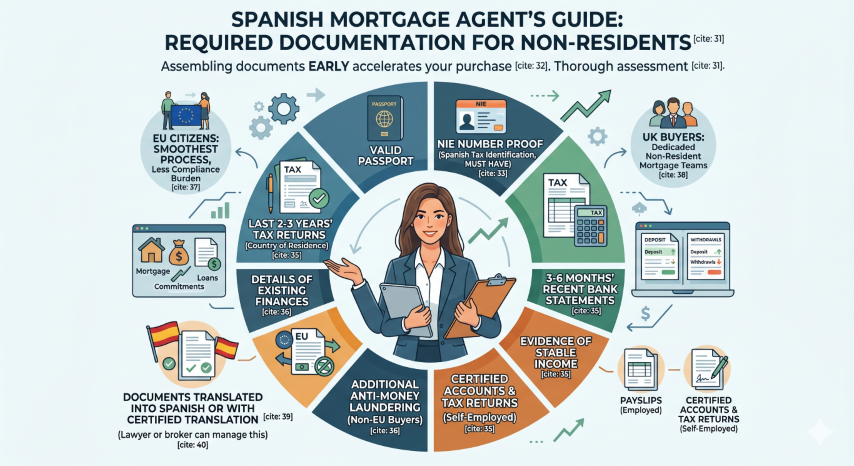
Spanish banks are thorough in their assessment of non-resident mortgage applications, and the documentation required is more extensive than most UK or Irish buyers are used to. Beginning the process of assembling your documentation before you find a property is the single most effective way to accelerate your purchase once the right opportunity appears.
You will need: a valid passport; proof of your NIE number (Número de Identificación de Extranjero, your Spanish tax identification number, which you must have before any property transaction can proceed); your last two to three years’ tax returns from your country of residence; three to six months of recent bank statements; evidence of stable income — payslips for employed buyers or certified accounts and tax returns for the self-employed; details of any existing mortgages, loans or financial commitments; and, for non-EU buyers, additional anti-money-laundering documentation that banks are now required to collect under strengthened 2026 regulations.
EU citizens benefit from the smoothest process, as common European data standards reduce the compliance burden. UK buyers, post-Brexit, sit in a slightly more document-intensive category but remain very well served by Spanish lenders, many of whom have dedicated non-resident mortgage teams. Most lenders will want documents translated into Spanish or accompanied by a certified translation; a good property lawyer or mortgage broker will manage this process on your behalf.
The Role of a Mortgage Broker

While it is entirely possible to approach Spanish banks directly, the majority of experienced international buyers on the Costa del Sol work with an independent mortgage broker who specialises in non-resident lending. The reasons are practical rather than commercial: a specialist broker will have established relationships with the lenders most active in the non-resident market, access to rates and terms that may not be advertised publicly, and the ability to identify which lender’s underwriting criteria best matches your specific financial profile.
Brokers also manage the bilingual communication process, translate documentation, liaise with the bank’s valuation team, and coordinate the mortgage timeline with your legal team and the developer or vendor. On complex transactions — particularly off-plan purchases, where the mortgage offer must align with the construction timeline — this coordination is invaluable. Most mortgage brokers on the Costa del Sol are remunerated by the lender rather than the buyer, making their services effectively cost-neutral to access.
The 2026 mortgage landscape on the Costa del Sol rewards buyers who are prepared, who understand the rules and who have assembled the right team around them. The financing is available, the rates are attractive, and the market continues to justify the investment. The question is simply whether you arrive at the property you want already mortgage-ready, or whether you arrive hoping to get there in time.
Thinking About Making the Move?
Our team of specialist advisors has been helping international buyers find their perfect home on the Costa del Sol for 15 years. Whether you are at the early stages of research or ready to view, we would love to hear from you.
T: +34 951 177 422 E: info@mosaicrealty.es W: www.mosaicrealty.es
COSTA DEL SOL — BUYING GUIDE
NIE Numbers, Notaries & Notarial Deeds: Everything You Need to Know Before You Buy
Your Expert Guide to Living and Investing on the Costa del Sol

Ask anyone who has bought a property in Spain what surprised them most about the process, and the same themes tend to emerge. Not the complexity — Spain’s property purchase system is, in fact, well-structured and legally robust. What surprises buyers most is the unfamiliarity: a cast of legal characters and procedural steps that simply do not exist in the same form in the UK, Ireland or Northern Europe.
Three elements in particular tend to generate the most questions: the NIE number, the role of the Notario, and the Notarial Deed (Escritura). Understanding each of them clearly — what they are, why they exist, and what they mean for you as a buyer — will make the entire process feel considerably less foreign and considerably more manageable.
This article addresses all three in depth, so that when the moment comes, you are not encountering them for the first time.
The NIE Number: Your Gateway to Everything
The NIE — Número de Identificación de Extranjero, or Foreigner’s Identification Number — is a unique tax identification number issued by the Spanish government to any non-Spanish national who needs to conduct legal or financial activity in Spain. It is, in the most practical sense, the key that unlocks everything else in the purchase process.
Without a NIE, you cannot sign a purchase contract. You cannot open a Spanish bank account. You cannot register a property in your name. You cannot, in short, buy a property in Spain. This is why obtaining your NIE is the very first practical step, and why we always advise buyers to begin the process as early as possible — ideally before they have even identified a specific property.
How to Obtain Your NIE
There are two routes to obtaining a NIE. The first is to apply in person at a Spanish consulate in your country of residence. This is typically the most convenient option for buyers who have not yet made the move to Spain. You will need to complete the application form (Modelo EX-15), provide your original passport and a photocopy, a completed Modelo 790 fee form, and documentation demonstrating the reason for your application — in the case of a property purchase, a letter from your lawyer or estate agent confirming your intention to buy.
The second route is to apply in person at a National Police station (Comisaría) in Spain, specifically at the Foreigners’ Department (Oficina de Extranjería). This route is viable if you are in Spain at the time of application and can take less time than applying from abroad.
The third — and for many international buyers the most practical — option is to appoint a lawyer in Spain who can obtain the NIE on your behalf via a Power of Attorney (Poder Notarial). You grant your lawyer limited legal authority to make the application in your name, which removes the requirement for you to be physically present in Spain. This is a well-established, entirely routine process and one your lawyer will have navigated many times before.
The Notario: Impartial Guardian of the Process
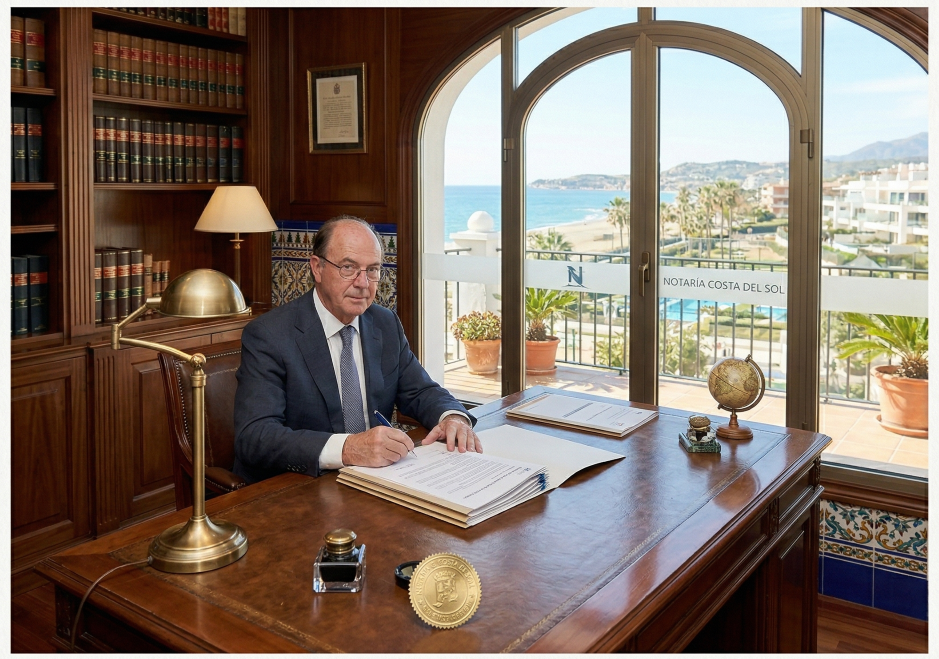
The Notario (Notary Public) is one of the most important figures in Spanish property law — and one of the most commonly misunderstood by international buyers. In Spain, notaries are senior legal professionals appointed directly by the Spanish state. They are not private practitioners in the conventional sense: they hold public office, and their role is to act as an impartial guarantor of the legal process, not as an advocate for either party.
The notary’s involvement in a property transaction is mandatory. No sale of real estate in Spain is legally complete without the buyer and seller appearing before a notary to execute the deed of sale. This requirement exists precisely because the notary’s role is protective: they verify the identity of the parties, confirm that the terms of the transaction are lawful and correctly documented, and ensure that both parties understand what they are signing.
What the notary does not do is conduct due diligence on your behalf. They will not check whether the property has outstanding debts, verify planning permissions, or advise you on whether the price is fair. That is the role of your independent lawyer, and it underscores why having your own legal representation — separate from the notary — is so important.
Notaries in Spain are distributed across every town and city. Your lawyer will typically recommend a notary they work with regularly, which is perfectly normal and entirely appropriate. The key point is that the notary’s impartiality is a matter of professional obligation, not personal relationship.
The Escritura: The Document That Makes It Real
The Escritura de Compraventa — literally, the Deed of Purchase and Sale — is the formal notarial document by which ownership of a property legally transfers from seller to buyer in Spain. It is, in the simplest terms, the Spanish equivalent of the completion documents you would sign at a conveyancing solicitor’s office in the UK or Ireland — but executed in a very different setting, with a very different weight.
The escritura is prepared by the notary in advance of the completion appointment. It sets out, in formal legal language, the full terms of the transaction: the identities of the parties, the description of the property and its registration details, the agreed purchase price, confirmation of the method of payment, and any conditions applicable to the transfer.
At the completion meeting, the notary will read the escritura aloud in its entirety — or summarise the key points where the document is lengthy — before both parties sign. If either party does not speak Spanish, an official interpreter must be present or the deed must be provided in a bilingual format. Your lawyer will ensure that this is properly arranged.
After the Escritura: Registration and Taxes
Signing the escritura is the moment of completion, but it is not quite the end of the process. Following completion, your lawyer will present the escritura to the Land Registry (Registro de la Propiedad) for registration in your name. This is a critical step: while the escritura itself constitutes legal proof of ownership, registration at the Land Registry provides public legal protection — formally establishing your title and protecting you against any subsequent claims on the property.
Simultaneously, your lawyer will arrange payment of the applicable purchase taxes. For resale properties in Andalucía, this is Transfer Tax (Impuesto de Transmisiones Patrimoniales) at 7% of the declared purchase price. For new-build properties, the applicable taxes are VAT (IVA) at 10%, plus Stamp Duty (Actos Jurídicos Documentados, or AJD) at 1.2%.
Both registration and tax payment have legally prescribed deadlines, and your lawyer will manage both to ensure you remain fully compliant and your title is protected from day one.
A Note on Powers of Attorney
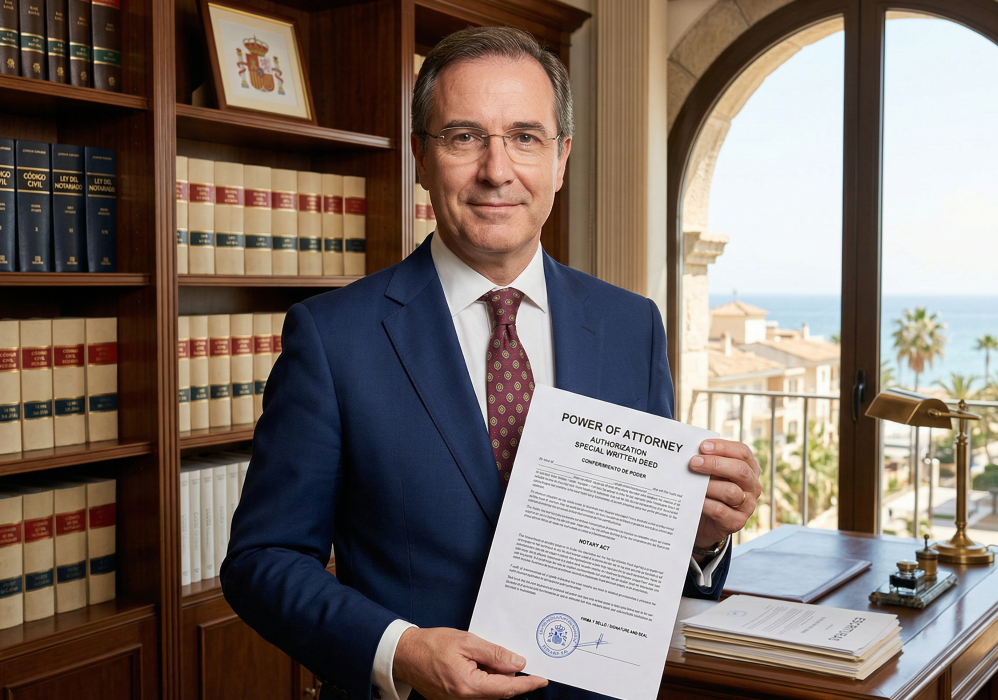
Many international buyers — particularly those purchasing from abroad and unable to be present in Spain at every stage — choose to grant their lawyer a comprehensive Power of Attorney (Poder Notarial). This is a notarially certified legal authority that allows your lawyer to act on your behalf at key points in the transaction, up to and including the completion itself.
A Power of Attorney does not diminish your control over the transaction. Your lawyer acts strictly within the scope of the authority you grant them, and you remain fully informed and in control at every stage. It is simply a practical tool that removes the requirement for you to be physically present in Spain at each step — a significant convenience for buyers based in the UK, Ireland, Scandinavia or elsewhere in Northern Europe.
The Power of Attorney itself must be executed before a notary — either in Spain, or at a Spanish consulate in your country of residence, or before a local notary with an apostille certification. Your lawyer will advise on the most appropriate route.
The Bigger Picture
Spain’s system of notaries, escrituras and NIE numbers may feel unfamiliar at first, but it is important to recognise that it exists for good reason: to provide legal certainty, to protect both parties in a transaction, and to ensure that property ownership in Spain is properly documented and publicly registered.
Once you understand the architecture of the system — and have the right advisors around you to navigate it — the process is not only manageable but reassuring. You are buying in a mature, well-regulated legal environment with genuine protections in place.
And on the other side of that process is a home on the Costa del Sol. It is, by any measure, worth understanding it properly.
Thinking About Making the Move?
Our team of specialist advisors has been helping international buyers find their perfect home on the Costa del Sol for 15 years. Whether you are at the early stages of research or ready to view, we would love to hear from you.
T: +34 951 177 422 E: info@mosaicrealty.es W: www.mosaicrealty.es
COSTA DEL SOL — BUYING GUIDE
The Complete Foreign Buyer’s Guide to Purchasing Property in Spain
Your Expert Guide to Living and Investing on the Costa del Sol

There is a particular kind of clarity that comes to people who have decided — really decided — to buy a property in Spain. The noise of the decision fades, replaced by something quieter and more purposeful: the desire to understand the process, to get it right, and to move forward with confidence. If you have reached that point, this guide is written for you.
Buying property in Spain as a foreign national is entirely straightforward — thousands of international buyers complete the process every year, many of them on the Costa del Sol. But like any significant transaction in an unfamiliar legal system, it rewards preparation. The buyers who navigate it most smoothly are those who understand the steps before they take them.
What follows is a comprehensive, honest and practical guide to the entire process — from your first viewing to the moment you receive the keys to your new home.
Step One: Obtaining Your NIE Number
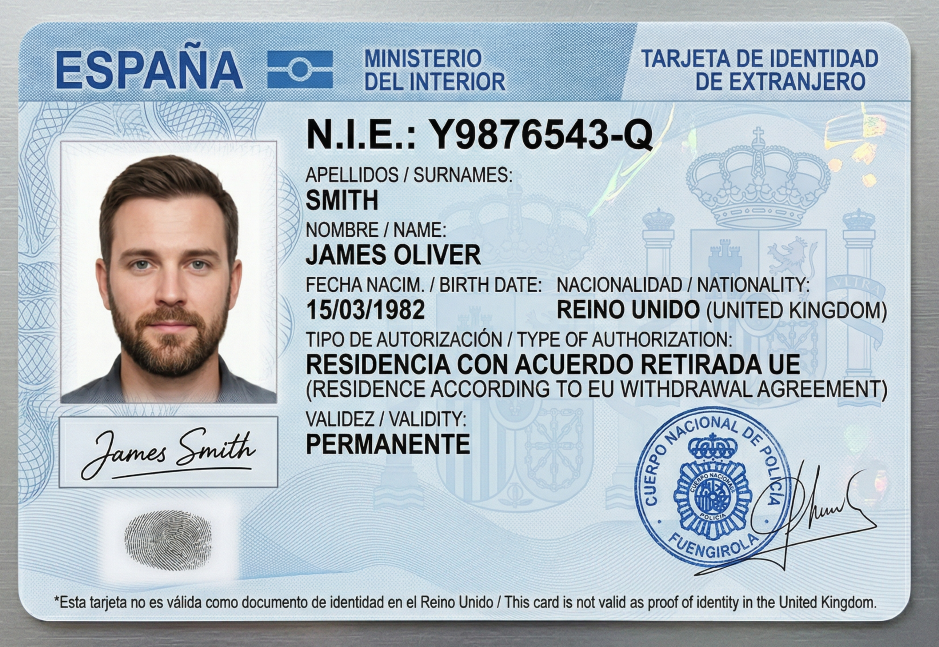
Before you can do anything of legal substance in Spain — including signing a purchase contract or opening a bank account — you will need a NIE number (Número de Identificación de Extranjero). This is your Spanish tax identification number, and it is the foundation upon which your entire purchase rests.
A NIE can be obtained in person at a Spanish consulate in your home country, or at a National Police station (Comisaría) in Spain. The process requires a completed application form (Modelo EX-15), your passport, and a small fee. Many buyers choose to appoint a local lawyer to obtain their NIE on their behalf via a power of attorney — a practical option if you are not yet resident in Spain and wish to move quickly.
Do not underestimate the importance of getting this done early. It is a simple step, but without it, nothing else can proceed.
Step Two: Appointing a Lawyer
Spanish property law is distinct from that of the UK, Ireland and Northern Europe in a number of important ways. While it is technically possible to proceed without independent legal representation, we would never recommend it. Your lawyer is not an optional extra — they are your most important investment in the entire transaction.
A good Spanish property lawyer will conduct thorough due diligence on your behalf: verifying that the property is correctly registered at the Registro de la Propiedad (Land Registry), checking for any outstanding debts or charges on the property, reviewing planning permissions and legal status, and ensuring that the title is clean and transferable. They will also review every contract before you sign and represent your interests at every stage, including at the notary.
Choose a lawyer who is independent of the developer or estate agent and who has demonstrable experience in Spanish property transactions. Many international buyers choose a bilingual lawyer — someone who can communicate fluently in both Spanish and English, ensuring that nothing is lost in translation at a critical moment.
Step Three: Opening a Spanish Bank Account
You will need a Spanish bank account to complete your purchase. All funds — your deposit, your stage payments if buying off-plan, and your final completion payment — must be transferred through a Spanish account. Your bank will also be the vehicle through which you pay your ongoing expenses: utility bills, community fees, property taxes, and so on.
Opening an account is straightforward for non-residents. Most major Spanish banks have English-speaking staff in their Costa del Sol branches, and the process typically requires only your passport, your NIE, and proof of address from your home country. Your lawyer can advise on the most convenient options for your particular circumstances.
Step Four: The Reservation Agreement and Deposit
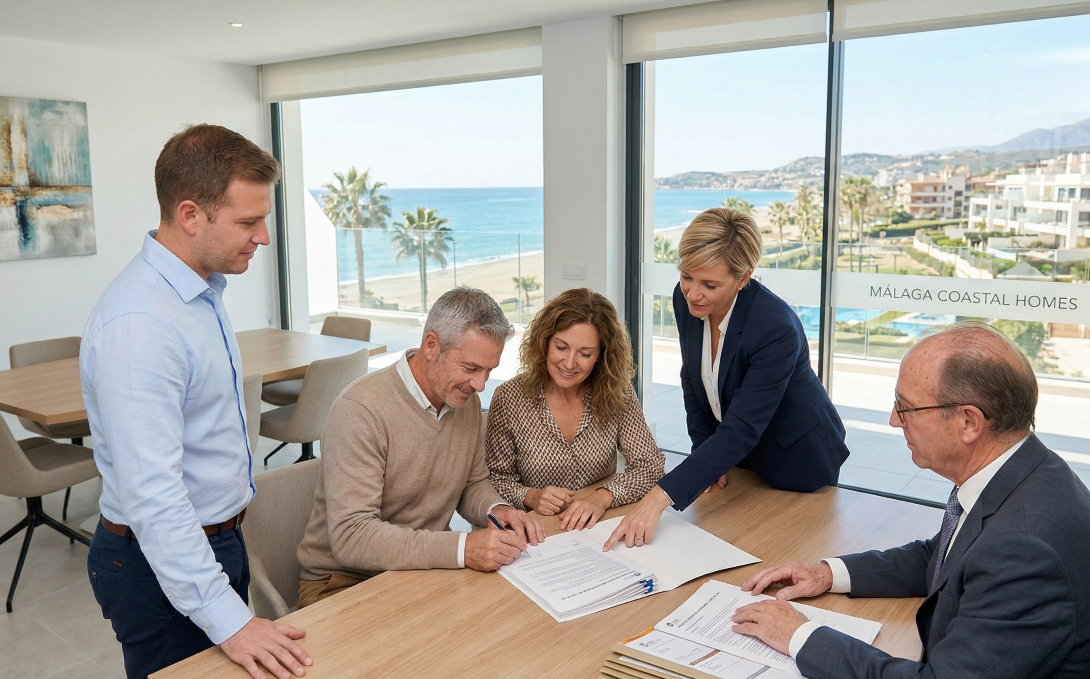
Once you have found your property and agreed a price in principle, the first formal step is typically a Reservation Agreement (Contrato de Reserva). This is a short document that takes the property off the market in exchange for a reservation deposit — usually between €3,000 and €10,000, depending on the property and the seller.
The reservation deposit is deducted from the final purchase price, but it is important to understand the conditions under which it is refundable — or not. Your lawyer should review the reservation agreement before you sign and ensure that your interests are properly protected.
Step Five: The Private Purchase Contract
The Contrato de Compraventa (Private Purchase Contract) is the substantive legal agreement between buyer and seller. This is the document that commits both parties to the transaction on the agreed terms: price, payment schedule (in the case of off-plan purchases), completion date, and any conditions or special clauses.
At the point of signing the private purchase contract, the buyer typically pays a deposit of 10% of the purchase price (less any reservation fee already paid). Under Spanish law, this deposit operates on a penalty basis: if the buyer withdraws without legal cause, they lose the deposit; if the seller withdraws, they must return the deposit doubled. Your lawyer will explain the specific terms in detail.
Step Six: Due Diligence
Between the private purchase contract and completion, your lawyer will conduct a comprehensive programme of due diligence. This is where the value of good legal representation is most clearly felt.
Key checks include: confirming clear title at the Land Registry; verifying that there are no debts, mortgages or encumbrances registered against the property; confirming that all community fees and local property taxes (IBI) are up to date; checking that the property has valid planning permissions and, where applicable, a first occupation licence (Licencia de Primera Ocupación); and reviewing any community statutes if the property forms part of an urbanisation or residential complex.
For new-build or off-plan properties, your lawyer will additionally verify that the developer holds all necessary licences, that your stage payments are protected by a bank guarantee, and that the building specification is accurately reflected in the contract.
Step Seven: Arranging Finance
If you require a mortgage to complete your purchase, it is essential to begin the process early. Non-resident buyers can obtain Spanish mortgages, though the terms differ from those available to residents — most notably in the loan-to-value ratio, which is typically capped at 60–70% for non-residents compared to up to 80% for residents.
Spanish lenders will assess your income, your existing financial commitments, and the independent valuation of the property. Processing times can vary, and a mortgage offer is generally required before a completion date can be confirmed. We work closely with experienced independent mortgage brokers who specialise in non-resident finance and can guide you to the most competitive products available in the current market.
Step Eight: Completion at the Notary
Completion in Spain takes place in the presence of a Notario — a public official appointed by the Spanish state whose role is to verify the identity of the parties, confirm the terms of the transaction, and ensure that the deed of sale (Escritura de Compraventa) is executed correctly. The notary is impartial: they represent neither buyer nor seller, but the integrity of the legal process itself.
At completion, the buyer pays the balance of the purchase price (typically by bank transfer or certified bank cheque), the notary reads and certifies the escritura, and ownership formally transfers. You will leave the notary’s office with a copy of the signed deed — and the keys to your new home.
Step Nine: Post-Completion Obligations
Completion is not quite the final step. In the weeks that follow, your lawyer will register the escritura at the Land Registry in your name — a critical step that formally establishes your legal ownership. They will also handle the payment of the relevant purchase taxes: Transfer Tax (Impuesto de Transmisiones Patrimoniales) on resale properties, or VAT (IVA) plus Stamp Duty (AJD) on new-build properties.
Once registration is complete, you will need to set up your utility accounts, register with the local municipality if you intend to be a resident, and ensure that any ongoing taxes — particularly the annual IBI (local property tax) — are correctly set up in your name.
The Costs You Should Anticipate
The total acquisition costs for a property purchase in Spain typically amount to between 10% and 13% of the purchase price, depending on the region and the type of property. These costs include purchase taxes (Transfer Tax at 7% for resale properties in Andalucía, or IVA at 10% plus AJD at 1.2% for new builds), Notary fees, Land Registry fees, and legal fees. Your lawyer and agent will provide you with a detailed cost estimate at the outset so that there are no surprises.
A Final Word
The Spanish property purchase process, approached with the right team around you, is genuinely manageable — and ultimately, deeply rewarding. The complexities exist not to deter buyers but to protect them, and the legal framework, when properly navigated, provides real security.
What matters most is choosing your advisors wisely: a good agent who knows the market, a good lawyer who knows the law, and a good broker who knows the finance. Get those three right, and the rest follows.
Thinking About Making the Move?
Our team of specialist advisors has been helping international buyers find their perfect home on the Costa del Sol for 15 years. Whether you are at the early stages of research or ready to view, we would love to hear from you.
T: +34 951 177 422 E: info@mosaicrealty.es W: www.mosaicrealty.es